

.webp)

What Charleston's 2026 Peptide Reclassification Means: A Functional Medicine Guide

If you follow longevity podcasts, you have heard the names: BPC-157, CJC-1295, ipamorelin, sermorelin. In early 2026 the conversation got louder, because the federal government moved to loosen the rules on several of these peptides, and the headlines declared them legal again. The reality is more complicated than the headlines, and if you are a Charleston woman trying to figure out whether peptide therapy is something you can actually and legally pursue, the gap between the hype and the regulatory facts matters.
This guide explains what genuinely changed in 2026, what is still pending, and how peptide therapy fits into a woman's healthspan, written by a functional medicine practitioner who would rather tell you the careful truth than the convenient version.
What actually changed in 2026, and what has not
In April 2026, the U.S. Food and Drug Administration removed twelve peptides from its Category 2 list, the designation reserved for substances the agency had flagged as posing significant safety risks for compounding[1]. The change followed public pressure, including comments from HHS Secretary Robert F. Kennedy Jr., and the withdrawal of the original nominations that had placed these peptides in the restricted category. That much is real, and it is a meaningful shift.
Here is the part the headlines skipped. Removal from Category 2 does not, by itself, make a peptide legal to compound. The FDA has stated this directly: taking a substance off the Category 2 list does not authorize its use in compounding and does not place it in the enforcement-discretion category that compounding pharmacies actually rely on[1]. Until the FDA takes final action, these peptides sit in a regulatory gray area.
Anyone telling you these compounds are simply legal again is ahead of the facts.
The next step is a public advisory meeting. The FDA's Pharmacy Compounding Advisory Committee is scheduled to meet on July 23 and 24, 2026, to review seven of these peptides, including BPC-157, TB-500, KPV, and MOTS-c, for possible inclusion on the 503A bulk drug substances list, the list that determines what licensed pharmacies may legally compound[2]. Five additional peptides are scheduled for a later meeting before the end of February 2027. A favorable vote would be a recommendation, not an instant green light, because the FDA then has to act on that recommendation through its own process[2].
So as of this writing in June 2026, the honest answer to "are these peptides legal now" is: the situation is improving, but it is not finished, and anyone telling you these compounds are simply legal again is ahead of the facts.
The three legal categories every patient should understand
The confusion makes more sense once you separate peptides into three distinct legal buckets, because they are not all in the same situation.
The first bucket, FDA-approved peptide drugs, have been through the complete approval process. When you get one through a licensed provider, you are getting an approved medication with established dosing and a known safety profile. The second bucket, compounded peptides from a licensed 503A pharmacy, is what most of the 2026 news is about. The third bucket, the gray market, is where the regulatory turbulence of the past two years pushed a lot of frustrated patients, and it is the riskiest way anyone can pursue peptide therapy.
Why most peptide content is not written for you
If you have tried to research peptides, you have probably noticed that almost everything is written for and by men, specifically the male biohacker and athlete audience focused on muscle recovery and performance. That framing leaves out the woman in her forties or fifties thinking about healthspan: the work of preserving energy, cognition, metabolic health, and tissue integrity through the second half of life.
The honest caveat first: peptide research overall is thin on women-specific data, and most of the compounds in the 2026 news have limited human clinical evidence of any kind. Anyone who tells you a peptide is proven to do something specific for women is overstating what the science currently supports. What can be said responsibly is that the goals women bring to a healthspan practice, sustained energy, recovery, metabolic and body-composition support, sleep quality, and tissue repair, are the same biological systems several of these peptides are being studied for. The right approach is to match a clearly defined goal to the most evidence-supported and legally accessible option, with realistic expectations, rather than chasing a podcast recommendation.
That goal-matching, done honestly and with attention to what is actually legal, is the heart of responsible peptide care.
The peptides people ask about most
These are the compounds Charleston patients ask about, described with what the evidence actually supports rather than what the marketing claims.
Studied primarily in animal models for tissue repair, gut healing, and inflammation. One of the seven peptides under FDA advisory review in July 2026. Human clinical evidence remains very limited, and it is not FDA-approved for any indication.
Growth-hormone-releasing peptides studied for sleep, recovery, and body composition. They signal the body's own growth hormone production rather than replacing it. Human evidence is limited, and they are available only through compounding under a prescription.
Another growth-hormone-releasing peptide, unusual in that it was originally an FDA-approved drug, later discontinued by its manufacturer, and is now accessed through compounding pharmacies with a prescription.
A copper peptide studied for skin, collagen, and tissue support, which places it in the aesthetic-longevity conversation, reframing skin health as a longevity marker rather than vanity.
Bremelanotide, relevant to sexual health, has an FDA-approved form for a specific indication in women, which makes it one of the better-evidenced peptides in the wellness conversation.
In every case, the responsible questions are the same: what is the actual evidence, what is the real legal pathway, and is this the right tool for your specific goal.
What is still restricted, and why the gray market is a real risk
Not every peptide moved in the 2026 changes. Several, including Melanotan II and certain growth-hormone-releasing-peptide compounds, were not part of the favorable review batch and remain restricted, generally because of more serious safety concerns.
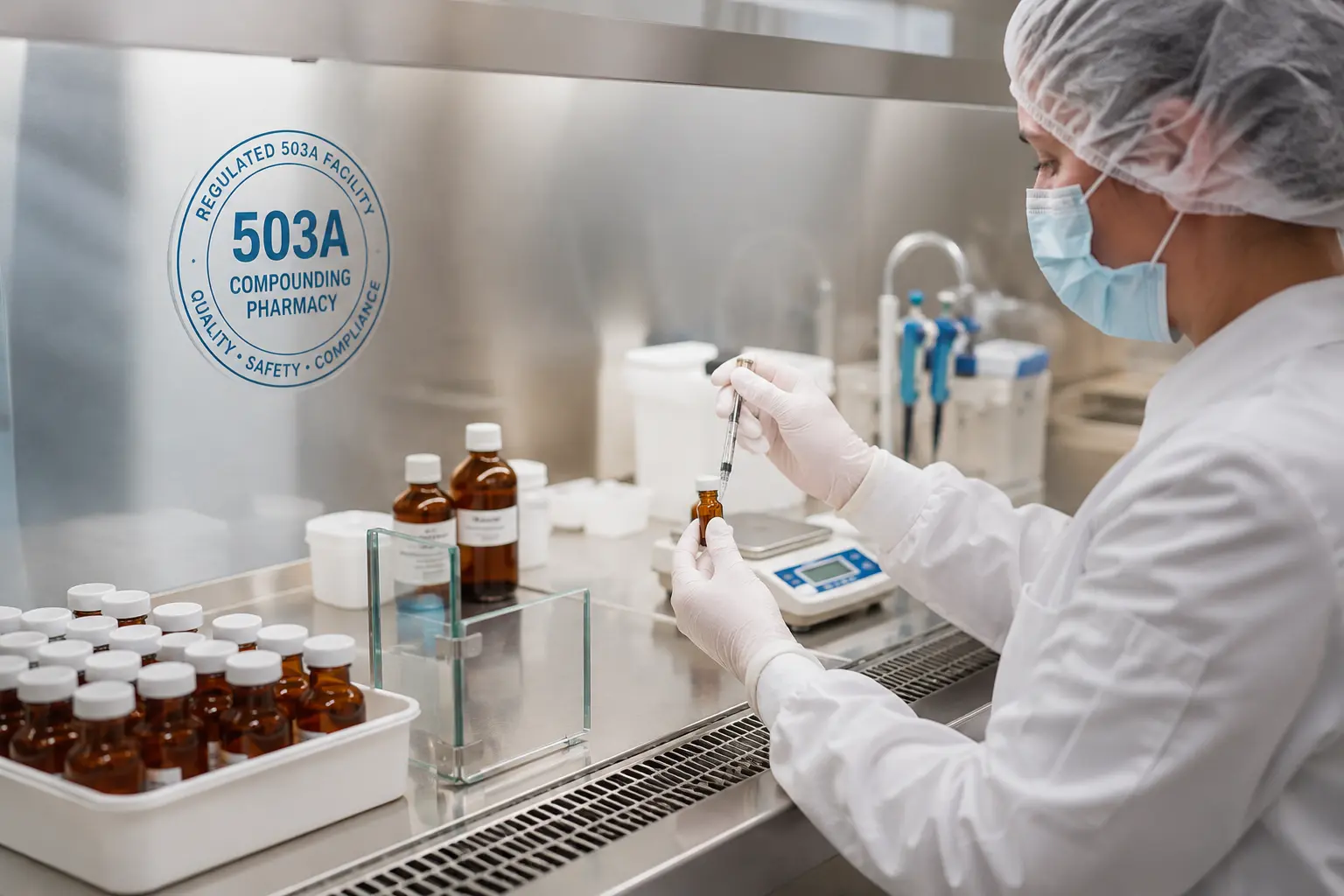
The bigger ongoing risk is the gray market that grew during the restricted years. When legitimate compounding access dried up, online vendors stepped in, selling peptides labeled "for research only" with no oversight of purity, sterility, or dose. Buying an injectable compound from an unregulated vendor and using it on yourself is the scenario most likely to cause harm, and it is the reason the regulatory normalization underway in 2026 matters: it is meant to pull patients back toward supervised, quality-controlled care. When you are evaluating any source, the standards that matter are third-party purity testing, a certificate of analysis you can verify, sterility, and a licensed prescriber standing behind the protocol.
How to pursue peptide therapy responsibly in Charleston
The legitimate pathway is straightforward. You see a licensed provider, you get a proper workup and an honest conversation about goals and evidence, and if a peptide is appropriate, the prescription is routed to a licensed 503A compounding pharmacy that prepares it under quality standards. The Charleston area has a growing number of clinics offering peptide therapy, and the difference between them is less the menu and more the discipline: training, honest sourcing, realistic expectations, and monitoring.

At Solcara Health, peptide therapy is one tool inside a complete healthspan picture rather than a standalone product. That means a peptide conversation starts with the same comprehensive workup that anchors our hormone and metabolic care, an honest discussion of what the evidence does and does not support, and a clear explanation of the legal status of any compound we discuss, including what is still pending after the July 2026 advisory meeting. For Charleston women in particular, peptides are considered alongside hormone status, metabolic health, and the other levers that actually move healthspan, not in isolation. Costs for peptide protocols in the Charleston market are typically out of pocket, since compounded peptides are rarely covered by insurance, and a transparent conversation about that is part of any responsible consultation.
Peptide therapy questions answered
The questions Charleston patients ask most often. Click any question to read Ashley's answer.
The honest version is the useful version
Peptide therapy is a genuinely promising and rapidly evolving area, and the 2026 regulatory changes are moving it toward safer, more legitimate access. But the distance between the podcast version and the regulatory reality is wide, and that gap is exactly where patients get hurt, either by buying from the gray market or by expecting results the evidence does not yet support. The most valuable thing a Charleston functional medicine practice can offer right now is not a longer menu of peptides. It is an honest map of what is legal, what is pending, what the evidence supports, and how any of it fits into your specific healthspan picture.
If you are curious whether peptide therapy has a legitimate role in your longevity plan, the right first step is a conversation grounded in evidence and current law, not a checkout cart.
Medical Disclaimer: This article is for educational purposes only and does not constitute medical advice. Peptide therapy involves individual factors, evolving regulations, and compounds that are largely not FDA-approved. Consult a qualified healthcare provider before making medical decisions. The information reflects the regulatory landscape as of June 13, 2026.
Ashley Harwyn, PA-C, is a Board Certified Physician's Associate in Anti-Aging and Functional Medicine (A4M). Solcara Health serves patients in South Carolina from offices in Mt. Pleasant (496 Bramson Ct, Ste 120) and Downtown Charleston (163 Rutledge Ave, Ste 202, The Longevity Club).

Quick Links