

Reviewed by Ashley Harwyn, PA-C, ABAAHP | A4M Board Certified | Updated October 4, 2026
NightLase may quiet snoring for some adults, but snoring can also signal sleep apnea. Here is how to tell the two apart, what the trial found, and where the laser fits.
The evidence is modest. One small sham-controlled trial found that three NightLase sessions made snoring quieter, as rated by bed partners three months later, but it only enrolled people whose sleep testing had already ruled out moderate or severe apnea.[5] A pooled review found no meaningful change in how often breathing stopped during sleep.[6] And the FDA clearance we read for the Fotona laser lists surgical and skin uses, not snoring or sleep apnea.[7]
- Snoring can be a sign of obstructive sleep apnea (OSA), in which the airway narrows or closes many times during sleep.[1]
- OSA is diagnosed with a sleep study, in a lab or at home, not with a questionnaire alone.[2]
- Breathing pauses, gasping, daytime sleepiness, or high blood pressure alongside snoring mean testing should come before any snoring treatment.[2]
- Diagnosed OSA has established treatments: positive airway pressure (such as CPAP), oral appliances, weight loss, and surgery, including nerve stimulation.[3][4]
- In one 40-person trial of people without significant apnea, NightLase reduced snoring compared with sham treatment at three months.[5]
- At Solcara, NightLase is a snoring option, not a sleep apnea treatment.
Is it snoring, or is it sleep apnea?
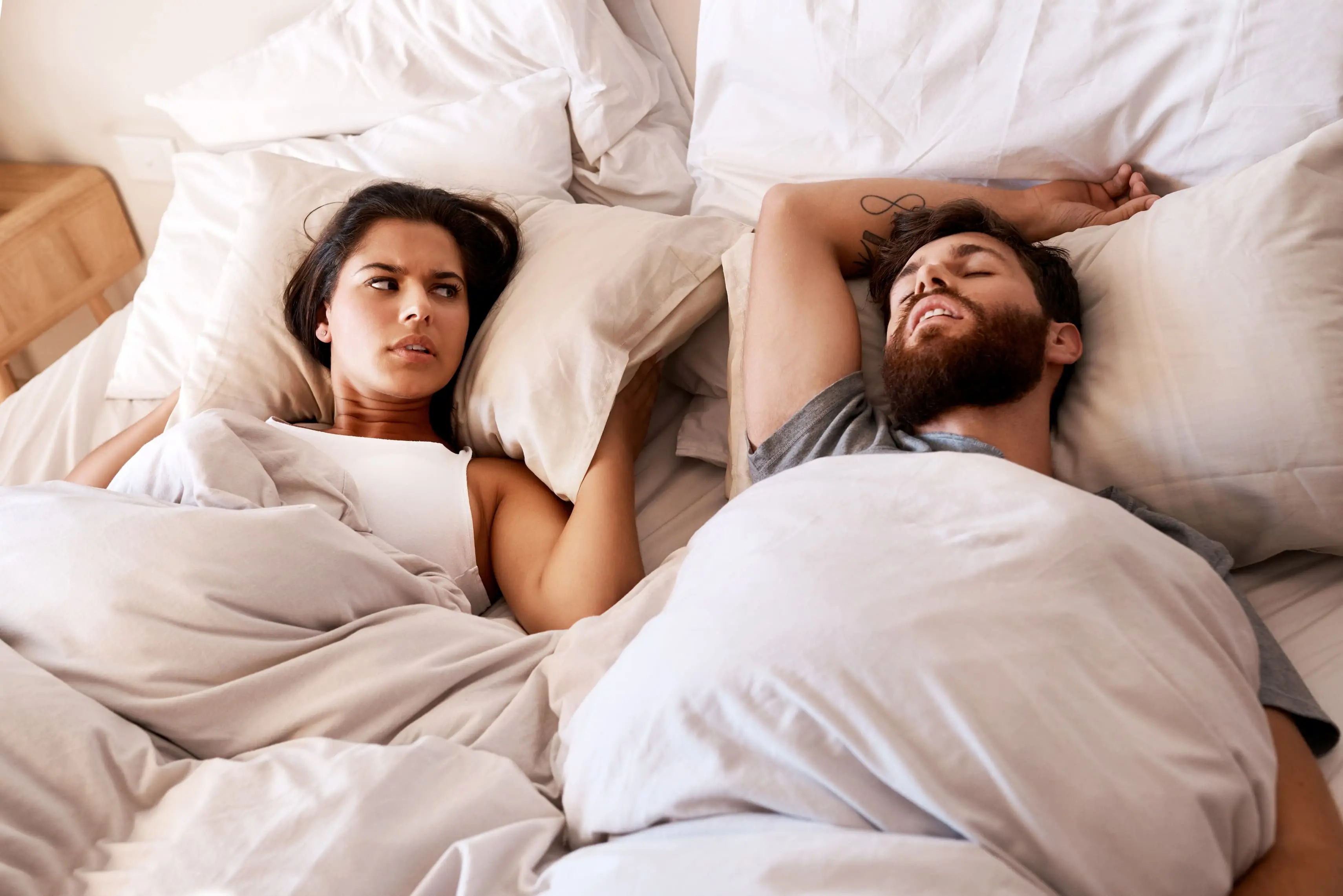
Snoring is the sound of relaxed throat tissue vibrating as air moves past it during sleep. It is common, especially with age and extra weight, and many things feed it: a stuffy nose, a crooked nasal septum, large tonsils, swelling in pregnancy, and alcohol or sedating medicine at bedtime.[1] For many people it is mostly a problem for whoever shares the room.
Obstructive sleep apnea is different. The airway does not just vibrate. It closes, or nearly closes, again and again, so breathing starts and stops. Snoring is one of its common signs, which is why loud snoring deserves a closer look.[1] The American Academy of Sleep Medicine (AASM) estimates that OSA affects about 14% of men and 5% of women. Untreated, it may raise the risk of hard-to-control blood pressure, heart disease, heart rhythm problems, and stroke, and it is linked with more car and work accidents.[2]
Some signs point toward apnea. A partner may see your breathing stop or hear choking and gasping. You may wake unrefreshed, feel very drowsy in the day, or get morning headaches.[1] The AASM adds a rule of thumb: daytime sleepiness plus at least two of loud habitual snoring, witnessed pauses or gasping, and diagnosed high blood pressure signals a higher risk of moderate to severe OSA.[2] If that sounds like you, a sleep study comes before any snoring treatment, including ours.
How a sleep study settles the question
Only a sleep study can separate simple snoring from OSA. The AASM recommends against diagnosing OSA from questionnaires or prediction tools alone.[2] The STOP-BANG questionnaire, for example, combines four yes-or-no questions with four facts such as age and neck size. It is good at flagging people who might have OSA, but it also flags many who do not and can miss some who do.[2] A high score is a reason to test, not a result.
Testing comes in two main forms: an overnight study in a sleep lab (polysomnography) or a home sleep apnea test with a simpler device. For otherwise uncomplicated adults with signs of moderate to severe OSA, the AASM says either can be used, and if a single home test is negative or unclear, an in-lab study should follow.[2]
The key number on the report is the apnea-hypopnea index (AHI), the count of times per hour that breathing stops or becomes shallow. It matters here because the main NightLase trial enrolled only adults with an AHI under 15, a body mass index of 30 or less, and no significant daytime sleepiness.[5] Here is how common situations line up with a sensible first step.
| What you or your partner notice | What it may point to | A sensible first step |
|---|---|---|
| Loud snoring, but you wake rested and alert | Possibly simple snoring | Self-care, then an evaluation before any procedure[1][4] |
| Snoring with pauses in breathing, gasping, or choking | Possible OSA | A sleep study before any snoring treatment[1][2] |
| Snoring plus daytime sleepiness and high blood pressure | Higher risk of moderate to severe OSA | A lab or home sleep study[2] |
| A sleep study shows OSA | OSA | PAP, an oral appliance, weight loss, or surgery[3][4] |
| Snoring with a blocked nose or large tonsils | A structural cause | A look at the nose and throat first[1][5] |
| Sleep testing finds no significant OSA | Primary snoring | An oral appliance or, for selected adults, NightLase[4][5] |
Sleep notes for your first visit
Tap anything that is true for you or that your partner has told you. This does not diagnose sleep apnea or decide whether NightLase fits. It simply gives you a list to bring to Ashley.
NightLase sits in the last row on purpose. Before any procedure, simple changes help some snorers: sleeping on your side, skipping alcohol and sedating medicines at bedtime, nasal strips for a stuffy nose, and losing weight if you carry extra.[1] Our medical weight loss program is one way to work on weight with support. For diagnosed OSA, the National Heart, Lung, and Blood Institute lists PAP machines, oral devices, mouth and tongue exercises, healthy habits, a recently approved weight-loss medicine for people with moderate to severe OSA and obesity, and surgery, including hypoglossal nerve stimulation.[3]
Snoring with pauses, gasping, or heavy daytime sleepiness? Start with the right question, not a laser. Call 843-981-0870 and Ashley will help you sort out whether a sleep evaluation should come first and what your options look like after it.
What NightLase does, and what the research measured
NightLase uses an erbium (Er:YAG) laser in a non-ablative mode, meaning it heats tissue without removing it. In the main trial, the beam was passed over the soft palate, uvula, tonsil area, base of the tongue, and back of the hard palate.[5] Researchers describe the aim as heat-triggered collagen remodeling that firms the lining so it vibrates and collapses less.[5] That is a proposed mechanism; the trial measured snoring, not tissue. Our laser services page shows how this fits with our other erbium treatments.
The strongest evidence is a 2022 randomized trial from Germany. Forty adults with bothersome snoring received three NightLase sessions over about six weeks or a sham treatment using a handpiece that blocked the light.[5] Three months later, bed partners rated snoring on a 0 to 10 scale. Average scores in the laser group fell from 7.9 to 4.7, while the sham group barely moved (8.1 to 8.0). Patients' own questionnaires improved too, and the differences between groups were statistically significant.[5]
The limits are real. The trial was small, follow-up lasted three months, and outcomes were questionnaires and partner ratings, not recorded sound or a repeat sleep study. Five of 20 sham patients dropped out, and the authors note that not everyone improved enough.[5] Fotona lent the laser, and the authors report the company did not fund the study or shape the analysis.[5] A 2020 meta-analysis of seven studies (247 people) found lower snoring scores and about 80% satisfaction, but no significant change in AHI, and called for randomized trials, objective data, and long-term results.[6]
What about the FDA? We read the 510(k) summaries for Fotona's Dynamis laser family, the platform used in the trial, including the newest one, cleared in September 2026. The erbium uses listed include surgery inside the mouth and “uvulopalatoplasty by laser resurfacing,” but snoring and sleep apnea are not named.[7] We found no clearance under the NightLase name. Any claim that this laser treats sleep apnea goes beyond what we could verify.
For adults whose sleep testing found no apnea or only mild apnea, a short series of in-mouth laser sessions that cut partner-rated snoring compared with sham at three months in one small trial, with mild, brief throat soreness.
Treating sleep apnea, replacing CPAP or an oral appliance, or skipping the sleep study. Pooled studies showed no significant change in AHI, and the FDA clearance we reviewed does not name snoring or apnea.
Who may be a good fit, and what a NightLase series involves
Based on who was studied, the best fit is an adult whose snoring bothers them or a partner, whose sleep testing found no OSA or only mild OSA, who is not very sleepy in the day, and whose snoring is not driven by a blocked nose or large tonsils.[5] If you have diagnosed OSA, NightLase does not replace your treatment, and you should not stop CPAP or an oral appliance because of it.
Know the option with guideline backing, too. For adults who want treatment of snoring without OSA, the AASM and the American Academy of Dental Sleep Medicine recommend an oral appliance prescribed by a sleep physician.[4] That guideline says primary snoring should be diagnosed by a sleep physician because snoring so often comes with OSA, and a missed diagnosis can have serious consequences.[4] We apply the same logic to lasers.
Your first visit is a conversation, not a treatment. Ashley Harwyn, PA-C, board certified in anti-aging and functional medicine (A4M) and ABAAHP certified, asks about your sleep, what your partner has noticed, your weight, blood pressure, nose, and medicines. If anything points to OSA, she will steer you to a sleep evaluation first, and our primary care service can help with blood pressure and weight. You can see her in Mount Pleasant at 496 Bramson Ct, Ste 120, or at The Longevity Club, 163 Rutledge Ave, Ste 202, in downtown Charleston.
NightLase is done as a series of sessions inside the mouth. In the trial, nobody needed numbing, and patients rated pain at about 3 out of 10.[5] The most common side effects were a mild sore or dry throat and a feeling of something in the throat, all gone by day three, with no ulcers or scarring.[5] We will not promise silence: results varied, and how long any benefit lasts is not well established.[6]
Primary Care
For the blood pressure and weight checks that often travel with sleep problems. Read Primary Care.
Medical Weight Loss
Since extra weight is a common driver of both snoring and sleep apnea. Read Medical Weight Loss.
Laser Services
To see how NightLase fits with the other Fotona treatments we offer. Read Laser Services.
Seeing the procedure: the manufacturer's video
The short video below is Fotona's own overview of NightLase. It is the company's promotional material, not independent evidence. Its description says the treatment reduces the effects of sleep apnea. That goes further than the research and FDA records on this page support.
 Ashley Harwyn, PA-C
PA-C, ABAAHP · Founder, Solcara Health
Online
Tap a question to ask
Find out what your snoring means first
Book an evaluation at The Longevity Club, 163 Rutledge Avenue downtown, or our Mount Pleasant office.
BOOK A CONSULTATION →Or call 843-981-0870
Ashley Harwyn, PA-C, ABAAHP
Founder, Solcara Health · Diplomate, American Board of Anti-Aging Health Practitioners (ABAAHP)
Ashley has practiced medicine for more than fifteen years. Her path into it began at home, with a family member born with a congenital heart defect and a childhood spent watching how much the quality of a clinician's attention could change the shape of a life. She has since practiced across a range of settings, including medical mission work in Uganda, before founding Solcara to build the kind of practice she kept wishing existed, one that treats patients as whole people and tells them the truth about what the evidence does and does not support.
Full bio →References
MedlinePlus, the AASM guidelines on diagnostic testing (2017) and oral appliance therapy (2015), NHLBI, the 2022 NightLase randomized trial, a 2020 meta-analysis, and FDA 510(k) summary K252723, each accessed October 4, 2026.
- MedlinePlus, National Library of Medicine. Snoring - adults. 2025. medlineplus.gov
- Kapur VK, Auckley DH, Chowdhuri S, et al. Clinical Practice Guideline for Diagnostic Testing for Adult Obstructive Sleep Apnea: An American Academy of Sleep Medicine Clinical Practice Guideline. Journal of Clinical Sleep Medicine. 2017. pmc.ncbi.nlm.nih.gov
- National Heart, Lung, and Blood Institute. Sleep Apnea: Treatment. National Institutes of Health. 2025. nhlbi.nih.gov
- Ramar K, Dort LC, Katz SG, et al. Clinical Practice Guideline for the Treatment of Obstructive Sleep Apnea and Snoring with Oral Appliance Therapy: An Update for 2015. Journal of Clinical Sleep Medicine. 2015. pmc.ncbi.nlm.nih.gov
- Picavet VA, Dellian M, Gehrking E, Sauter A, Hasselbacher K. Treatment of snoring using a non-invasive Er:YAG laser with SMOOTH mode (NightLase): a randomized controlled trial. European Archives of Oto-Rhino-Laryngology. 2022. pmc.ncbi.nlm.nih.gov
- Neruntarat C, Khuancharee K, Shoowit P. Er:YAG laser for snoring: a systemic review and meta-analysis. Lasers in Medical Science. 2020. pubmed.ncbi.nlm.nih.gov
- U.S. Food and Drug Administration. 510(k) Premarket Notification K252723: Dynamis Pro Family (Fotona). 2026. accessdata.fda.gov
Medical Disclaimer: This page is for educational and informational purposes only and does not constitute medical advice, and reading it does not create a patient-provider relationship. It describes general medical information and categories of care, not a recommendation that any individual start, stop, or change any test, treatment, or medication. Any diagnosis or treatment decision requires evaluation by a qualified, licensed clinician who knows your personal and family history. Consult a qualified healthcare provider before making medical decisions. Information reflects sources available as of October 4, 2026.
Ashley Harwyn, PA-C, ABAAHP, is a Diplomate of the American Board of Anti-Aging Health Practitioners (ABAAHP) through A4M and the founder of Solcara Health. Solcara serves South Carolina from Downtown Charleston (163 Rutledge Ave, Ste 202, The Longevity Club) and Mt. Pleasant (496 Bramson Ct, Ste 120).
NightLase® FAQ's

Quick Links
