

Reviewed by Ashley Harwyn, PA-C, ABAAHP | A4M Board Certified | Updated October 4, 2026
Stretch marks and scars can be made less noticeable, not erased. Here is how a mark's age and type decide the plan, and what the research actually supports.
Two facts shape everything below. First, a mark's age and color decide which tools can reach it.[1][4] Second, raised scars are their own problem. A keloid usually calls for steroid treatment inside a combined plan, with a laser playing a supporting role rather than the lead.[3][6]
- Stretch marks are scars. No treatment removes them, but several can make them less noticeable.[1]
- New stretch marks are often red, pink, or purple. Older ones fade and sink, and that stage changes which treatment fits.[1][4]
- Prescription tretinoin and hyaluronic acid have helped early stretch marks in studies. Almond oil, cocoa butter, olive oil, and vitamin E have not.[1]
- In a network meta-analysis of 14 stretch mark trials, blinding was unclear in 12, so treatment rankings are still uncertain.[5]
- Keloids grow past the edge of the original wound and often return. Steroid treatment and combined plans come first, and lasers mainly help with color, itch, and height.[3][6]
- Silicone gel sheets are widely used for raised scars, but a Cochrane review rated the research behind them as poor quality.[7]
Red or white: why a stretch mark's age changes the plan
A stretch mark forms when skin stretches or shrinks quickly and the collagen and elastin that hold it up tear.[1] Growth spurts in puberty, pregnancy, fast weight gain or loss, and rapid muscle growth from weight training are the usual triggers. Corticosteroid use, Cushing's disease, and Marfan syndrome are also linked, and a family history raises your odds.[1] Stretch marks are about twice as common in women as in men.[4]
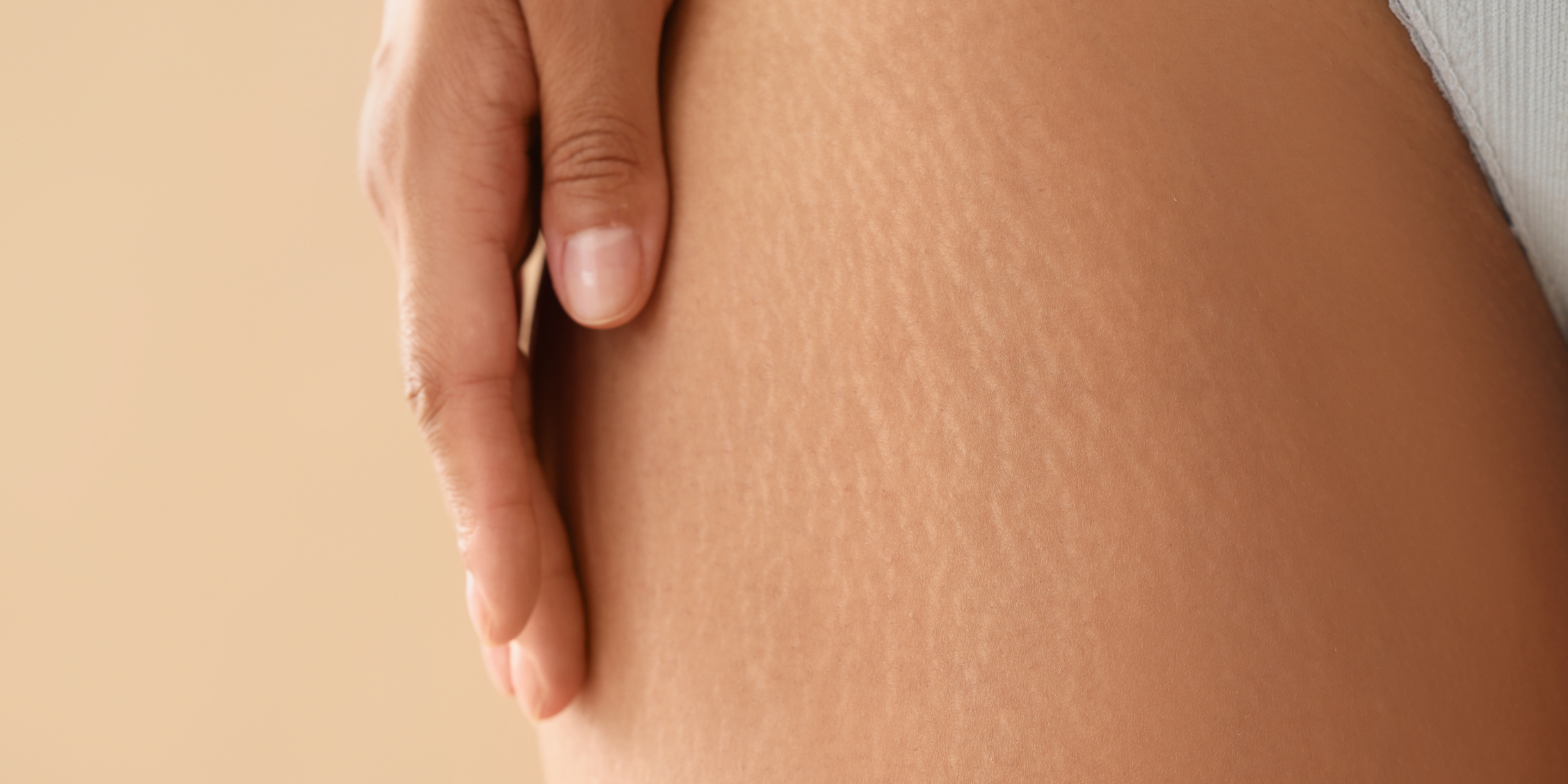
New marks tend to be red, purple, pink, reddish brown, or dark brown, depending on your skin color, and they may feel slightly raised or itchy.[1] Clinicians call this early stage striae rubra. Over time the color fades and the narrow bands sink below the surface, becoming pale, finely wrinkled lines called striae alba.[1][4]
Stage matters because each treatment has a different target. Early marks still have small blood vessels feeding their color, so lasers aimed at redness do more for red marks than white ones.[4] Prescription creams also have their best evidence in early marks. In one study, people who applied tretinoin every night for 24 weeks had less noticeable stretch marks, and in two large studies, hyaluronic acid applied to early marks made them less noticeable.[1]
Mature white marks are mostly a texture problem. Fractional carbon dioxide (CO2) laser resurfacing has done better on mature marks than on early ones in published studies.[4] At any stage, a self-tanner can camouflage the marks while you decide.[1]
If you are pregnant or breastfeeding, check with your clinician before treating stretch marks, because some ingredients, such as retinoids, can harm a baby.[1] If a pregnancy is in your near future, tell us, since it changes what makes sense now.
Lighter color in early stretch marks, smoother texture in older ones, and flatter, less itchy raised scars, built over a series of visits with settings matched to your skin tone.
Stretch marks that disappear, one laser setting for every scar type, a keloid handled by laser alone, or identical results and no downtime on every skin tone.
Surgical, injury, and raised scars are not one problem
Scars from surgery, a cut, a burn, or a scrape heal in different ways, and many settle into a flat line that differs in color or texture from the skin around it. The American Academy of Dermatology says lasers and other light treatments can decrease scarring after surgery, lessen redness, make raised scars and keloids less visible, and ease pain, itch, hardness, and swelling.[2]
Raised scars come in two forms. A hypertrophic scar is thick and raised but stays inside the borders of the original wound. A keloid spreads past those borders into healthy skin.[6] Silicone gel can reduce the size, hardness, redness, and itch of a raised scar, and it can help prevent one after surgery.[2] Keloids are tougher: some return after treatment, so dermatologists often combine two or more methods.[3]
Keloids are more common in people of Asian and African descent than in white people, and those on the chest, shoulder blades, and upper pubic area are especially likely to return after removal.[6] If you have had a keloid before, you can form another one later, so tell us before anything that breaks the skin.[3]
One laser setting does not suit every scar. For keloids in adults, Japan Scar Workshop guidance starts with strong steroid tape or plaster for about three months, adding steroid injections if needed.[6] Injections shrink 50 to 80 percent of keloids, though many regrow within five years, and on darker skin they can leave light spots.[3] Cutting a keloid out on its own has a high return rate, so removal is usually paired with other treatment.[3][6] Lasers can reduce a keloid's height and fade its color as one part of a larger plan.[3]
Which treatments fit which mark
Each row pairs a kind of mark with its best-supported options and a realistic goal.
| Mark | What you see | Options with the best support | Realistic goal |
|---|---|---|---|
| Early stretch marks | Red, pink, purple, or dark brown lines, sometimes raised or itchy[1] | Prescription tretinoin or hyaluronic acid; lasers that target redness[1][4] | Less color, less noticeable lines |
| Mature stretch marks | Pale, sunken, finely wrinkled bands[4] | Fractional laser, radiofrequency, microneedling, often combined[1][4][5] | Smoother texture, not removal[1] |
| Flat surgical or injury scar | A line that differs in color or texture[2] | Laser or light treatment, silicone, daily sunscreen[2] | A scar that blends in better |
| Hypertrophic scar | Firm and raised, inside the original wound[6] | Silicone, steroid tape or injection, laser for redness and itch[2][6] | Flatter, softer, less red |
| Keloid | Raised scar that spreads past the wound edge[6] | Steroid injections plus other treatments; laser as a helper[3][6] | Smaller and calmer; return is common[3] |
Details that shape your plan
Tap any line that fits you. This does not sort your marks or choose a treatment. It builds a short list of points to raise with Ashley at your visit.
At Solcara, laser work on these marks is done on our Fotona laser platform. Its erbium (Er:YAG) mode resurfaces the top layers of skin, and its Nd:YAG mode heats deeper tissue without removing the surface, so we pick the mode and depth for each mark. Research on Nd:YAG for stretch marks is mixed: one study found no meaningful improvement after four sessions, while others reported gains at particular settings.[4] Erbium resurfacing has a smaller body of stretch mark research, including a study that found reduced stretch mark volume.[4]
Fractional CO2 lasers ranked highest among the lasers in a 2020 network comparison of stretch mark treatments, but the very top spots went to bipolar radiofrequency, alone or with tretinoin.[5] Our skin resurfacing page explains how the erbium and Nd:YAG modes differ, and the laser services page shows everything else the platform is used for.
Microneedling uses fine needles to make tiny, controlled punctures, and two research groups independently reported marked improvement in stretch mark appearance and texture with it.[4] Platelet-rich plasma (PRP), made from your own blood, outranked tretinoin cream alone in the network comparison.[5] We offer PRP as an optional add-on, not a required upgrade, and aftercare includes ALASTIN skincare products made for skin after procedures.
What the stretch mark and scar research actually shows
A 2020 network meta-analysis compared 12 stretch mark treatments, including lasers, radiofrequency, microneedling, PRP, and tretinoin, across 14 randomized trials with 651 people.[5] Tretinoin with bipolar radiofrequency was most likely to rank first, then radiofrequency alone. Fractional CO2 led the lasers, and tretinoin cream alone ranked near the bottom.[5]
Those rankings are probabilities of being the best option, not the share of people who improved. Blinding was unclear in 12 of the 14 trials, and the authors rated certainty as moderate and asked for larger trials.[5] An earlier review was blunter: laser results in stretch marks are inconsistent, no fully effective treatment has emerged, and several sessions with more than one method are often needed.[4]
A Cochrane review of silicone gel sheeting pooled 20 trials with 873 people.[7] Silicone reduced raised scarring in people prone to it and improved scar thickness and color in treatment studies, but the trials were of poor quality and highly open to bias, so the authors called the prevention evidence weak and said a great deal of uncertainty remains.[7] Silicone is still low risk, as long as you know the evidence is soft.
For keloids, one guideline reports that 50 to 80 percent return after removal alone, falling to 10 percent or less when radiation follows within a week.[6] Vascular lasers mainly ease redness and itch in these scars.[6] The practical message: expect gradual improvement over several sessions, often with more than one method, and be wary of anyone promising your marks will disappear.
Not sure if your marks are early, mature, or a raised scar? A short in-person look usually answers that, and the answer decides where a plan begins. Call 843-981-0870 to book a scar and stretch mark visit with Ashley, and mention any keloids you have had before.
Planning sessions, skin tone, and aftercare
A laser visit starts with numbing cream, and most people feel mild heat during treatment. Stretch marks and scars almost always need a series of sessions, and the number depends on the mark, its age, and how your skin responds. Plan to keep treated skin out of the sun for at least a week afterward. After that, the American Academy of Dermatology advises a broad-spectrum sunscreen of SPF 30 or higher on any scar that clothing does not cover.[2]
Skin tone shapes the settings. Fractional resurfacing can cause redness, pain, crusting, and color changes, and those color changes are more of a concern in darker skin.[4] Lasers aimed at redness also carry a higher risk of dark marks in skin types IV to VI.[4] That calls for careful settings and honest expectations, not ruling treatment out. If flat dark marks are your main concern, see our hyperpigmentation page.
Ashley Harwyn, PA-C, who is board certified in anti-aging and functional medicine and holds ABAAHP certification, reviews your marks and history first: how old they are, what caused them, any keloids, and what you have already tried. If a scar would be better served elsewhere, for example by a surgeon, she will tell you directly.
Appointments are available at our Mount Pleasant office at 496 Bramson Court, Suite 120, and at The Longevity Club, 163 Rutledge Avenue, Suite 202, in downtown Charleston. If you have early photos of your marks, bring them.
Acne Scar Treatment
For pitted or raised scars left by breakouts. Read Acne Scar Treatment.
Laser Services
An overview of every Fotona treatment we offer. Read Laser Services.
Microneedling
A non-laser option for stretch mark texture. Read Microneedling.
Platelet-Rich Plasma (PRP)
How PRP is prepared and where it fits. Read Platelet-Rich Plasma (PRP).
 Ashley Harwyn, PA-C
PA-C, ABAAHP · Founder, Solcara Health
Online
Tap a question to ask
Find out what your marks will respond to
Book a visit with Ashley to sort out your stretch marks or scars, go over what you have already tried, and plan treatment that fits your skin.
BOOK A CONSULTATION →Or call 843-981-0870
Ashley Harwyn, PA-C, ABAAHP
Founder, Solcara Health · Diplomate, American Board of Anti-Aging Health Practitioners (ABAAHP)
Ashley has practiced medicine for more than fifteen years. Her path into it began at home, with a family member born with a congenital heart defect and a childhood spent watching how much the quality of a clinician's attention could change the shape of a life. She has since practiced across a range of settings, including medical mission work in Uganda, before founding Solcara to build the kind of practice she kept wishing existed, one that treats patients as whole people and tells them the truth about what the evidence does and does not support.
Full bio →References
American Academy of Dermatology patient guidance on stretch marks, scars and keloids, a stretch mark treatment review, a network meta-analysis, the Japan Scar Workshop consensus document, and a Cochrane review, each accessed October 4, 2026.
- American Academy of Dermatology. Stretch marks: Why they appear and how to get rid of them. AAD. 2026. aad.org
- American Academy of Dermatology. Scars: Diagnosis and treatment. AAD. 2026. aad.org
- American Academy of Dermatology. Keloid scars: Diagnosis and treatment. AAD. 2023. aad.org
- Lokhande AJ, Mysore V. Striae Distensae Treatment Review and Update. Indian Dermatology Online Journal. 2019. pmc.ncbi.nlm.nih.gov
- Lu H, Guo J, Hong X, et al. Comparative effectiveness of different therapies for treating striae distensae: A systematic review and network meta-analysis. Medicine (Baltimore). 2020. pmc.ncbi.nlm.nih.gov
- Ogawa R, Akita S, Akaishi S, et al. Diagnosis and treatment of keloids and hypertrophic scars: Japan Scar Workshop Consensus Document 2018. Burns & Trauma. 2019. pmc.ncbi.nlm.nih.gov
- O'Brien L, Jones DJ. Silicone gel sheeting for preventing and treating hypertrophic and keloid scars. Cochrane Database of Systematic Reviews. 2013. pubmed.ncbi.nlm.nih.gov
Medical Disclaimer: This page is for educational and informational purposes only and does not constitute medical advice, and reading it does not create a patient-provider relationship. It describes general medical information and categories of care, not a recommendation that any individual start, stop, or change any test, treatment, or medication. Any diagnosis or treatment decision requires evaluation by a qualified, licensed clinician who knows your personal and family history. Consult a qualified healthcare provider before making medical decisions. Information reflects sources available as of October 4, 2026.
Ashley Harwyn, PA-C, ABAAHP, is a Diplomate of the American Board of Anti-Aging Health Practitioners (ABAAHP) through A4M and the founder of Solcara Health. Solcara serves South Carolina from Downtown Charleston (163 Rutledge Ave, Ste 202, The Longevity Club) and Mt. Pleasant (496 Bramson Ct, Ste 120).




Scar & Stretch Mark Revision FAQ's

Quick Links
