

Reviewed by Ashley Harwyn, PA-C, ABAAHP | A4M Board Certified | Updated October 4, 2026
SkinPen microneedling can soften acne scars and neck wrinkles over a series of sessions. Here is what it is cleared for, how much change to expect, and how recovery goes.
That gap between “soften” and “erase” is where most microneedling marketing goes wrong. In the study FDA reviewed for SkinPen, a little over half of treated adults improved on blinded photo grading six months after three sessions, and the rest showed no change.[2] Below we cover the cleared uses, the research, when adding platelet-rich plasma makes sense, and recovery.
- Fine needles make tiny, controlled punctures, and the skin builds new collagen as it heals.[4]
- SkinPen is FDA-cleared for facial acne scars in adults 22 and older across all Fitzpatrick skin types, and for neck wrinkles in Fitzpatrick types II to IV. Stretch marks are not on that list.[3]
- In the SkinPen study, 11 of 20 people improved on blinded grading at six months and 9 showed no change.[2]
- Acne scars usually need 3 to 5 sessions spaced 2 to 4 weeks apart, and full results take several months to show.[4]
- FDA has not cleared any microneedling device for use with another product, including serums, drugs, or platelet-rich plasma (PRP).[1]
- Redness, dryness, or peeling for a few days is common. Dark or light spots, cold sore flares, or infection are less common.[1][2]
What happens in your skin during microneedling
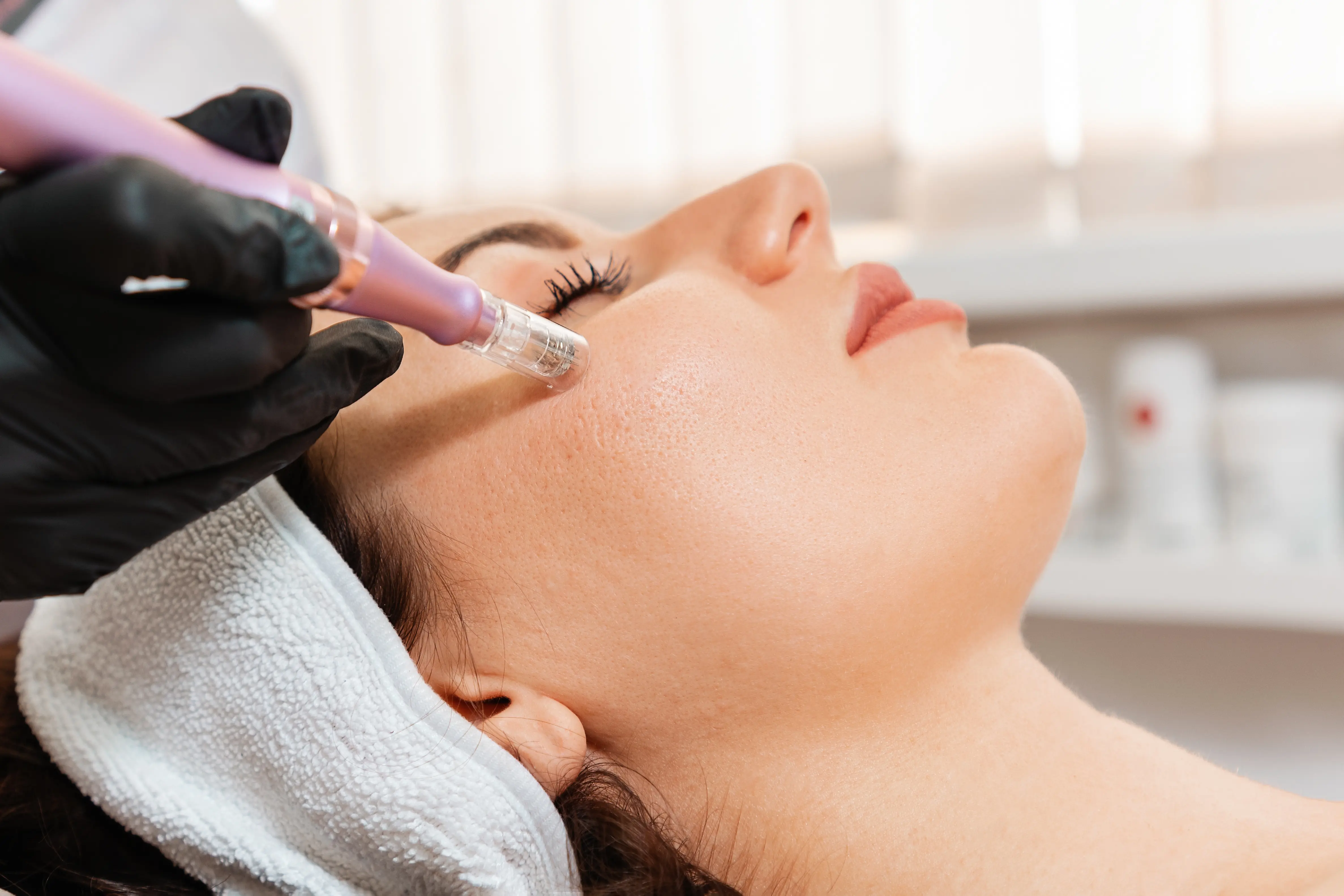
Microneedling, also called collagen induction therapy, uses a motorized pen that moves a cartridge of very fine needles across the skin.[1][4] FDA describes this type of device as one that uses needles to “mechanically puncture and injure skin tissue” for an aesthetic purpose.[2] That small, deliberate injury is the idea: as the skin repairs it, new collagen forms, which can gradually firm and even out the area.[4]
Depth matters. In the FDA review, SkinPen was studied at needle depths of up to 1.5 mm, and the agency noted that deeper settings have not been evaluated and are not recommended, because nerves and blood vessels run beneath the skin.[2] For the same reason, FDA advises getting microneedling from a health care provider with special training in it, and no medical microneedling device is authorized for over-the-counter sale.[1]
Home rollers are a different product. Rollers with short, blunt needles that only claim to exfoliate are not medical devices, and at-home or spa versions are not meant to puncture the skin, so their results are less noticeable.[1][4]
Healing is slow by design. You may see some change within a few weeks, but the full effect usually takes several months.[4] Judge it by photos taken in the same light before the series and months after, not by the mirror the next morning.
Gradually soften the look of depressed acne scars, and neck wrinkles in some skin types, over a series of sessions with a few days of redness, using a sterile, FDA-cleared device in trained hands.
A way to erase scars or stretch marks, a painless lunch-break fix, or a channel for pushing serums, fillers, or other products deep into the skin. FDA has not cleared any microneedling device for use with another product.
What SkinPen is cleared for, and what it is not
FDA regulates microneedling devices that pierce the skin as medical devices.[1] SkinPen was first authorized in 2018 through FDA's De Novo pathway, which set up the regulatory category for microneedling devices used for aesthetic purposes.[2] Later clearances added neck wrinkles to its labeled uses.[3] “Cleared” applies to those specific uses, not to every use you see advertised.
Across all brands, FDA has cleared microneedling devices to improve the look of facial acne scars, facial wrinkles, and abdominal scars in people 22 and older.[1] SkinPen's own labeling is narrower: facial acne scars in adults of all Fitzpatrick skin types, and neck wrinkles in Fitzpatrick types II to IV, a middle band of the six-type scale.[3] Dermatologists also use microneedling for stretch marks, enlarged pores, uneven texture, and dark spots.[4] Those are reasonable clinical uses, but they sit outside SkinPen's cleared indications, and you deserve to know that before you book.
| Concern | FDA status for SkinPen | What to realistically expect |
|---|---|---|
| Depressed facial acne scars | Cleared for adults 22 and older, all Fitzpatrick skin types[3] | Gradual, partial softening over a series of sessions[2][4] |
| Neck wrinkles | Cleared for Fitzpatrick skin types II to IV[3] | Results build over months as collagen forms[4] |
| Stretch marks | Not a cleared use[3] | Early evidence; similar to lasers in pooled small studies[7] |
| Pores, texture, dark spots | Not a cleared use[3] | Used by dermatologists; ask what else could work[4] |
| PRP added during treatment | No device is cleared for use with another product[1] | Small, mostly split-face studies favor it for acne scars[6] |
Points to raise at your consult
Mark whatever applies to you. This is not a screening test and it cannot tell you whether you are a candidate. It simply builds a short list of things to mention first.
One practice to be wary of is using the needle channels to push serums, “growth factor” products, or diluted fillers into the skin. SkinPen's FDA review states plainly that it is not intended to deliver topical products such as cosmetics, drugs, or biologics under the skin.[2] FDA adds that because no microneedling device is cleared for use with another product, the agency has not reviewed whether those combinations are safe or effective.[1] Ordinary aftercare on the skin surface is a different matter.
Hair loss is another common claim, but FDA has not cleared any microneedling device for it.[1] For thinning hair, see our PRP hair restoration page instead.
How much change the studies actually show
The best place to start is the study FDA reviewed for SkinPen. It took place at one center, with three treatments about a month apart and follow-up visits one and six months after the last session.[2] Twenty adults were treated with the final SkinPen device, and two blinded dermatologists graded each person's acne scars from standardized photos.[2]
Six months after the last session, 7 of the 20 had improved by one full grade on the scar scale, 4 more had improved by less than a grade, and 9 showed no change.[2] No one was graded worse. The group's average score moved from 2.80 to 2.35, and both of those numbers sit in the “mild” range of the scale.[2] People rated themselves more generously: 18 of 20 said their scars looked at least somewhat better, with the average answer in the 1 to 25 percent improvement band.[2]
Read those numbers both ways. Microneedling helped more than half the group in a way trained graders could see, and it made no one worse. It also left nearly half unchanged, and the typical gain was a step, not a transformation. One small study cannot predict which group you will land in.
The wider research is more cautious still. A Cochrane review of acne scar treatments found a lack of high-quality evidence for any of them, citing small trials, poor methods, and inconsistent measures.[5] In one small trial it included, skin needling and a chemical peel produced similar scar improvement.[5] The reviewers also warned that when two active treatments look alike and neither is compared with a sham, it is possible that neither one works.[5] That is a reason to distrust anyone promising a specific percentage.
For stretch marks, a 2024 meta-analysis pooled 11 studies, six of them randomized, and found microneedling roughly as effective as lasers, with more pain during treatment than laser.[7] The authors described their findings as initial evidence.[7] If stretch marks are your main concern, our scar and stretch mark page compares the options side by side.
Skin tone deserves a straight answer. SkinPen's acne scar clearance covers all Fitzpatrick skin types, and 11 of the 41 people in its safety data had type V or VI skin.[2][3] In one small Cochrane-reviewed trial, 6 of 12 people developed darkening after a chemical peel versus 0 of 15 after needling, and the stretch mark analysis also found less darkening with microneedling.[5][7] Lower risk is not zero risk. FDA lists dark or light spots as possible side effects.[1] If you tend to get dark marks after a pimple, see our hyperpigmentation page and mention it at your consult.
Not sure your scars are the kind that respond? A photo cannot answer that, but an in-person look can. Call 843-981-0870 to have your skin examined, your products and medicines reviewed, and a frank talk about whether microneedling, a different treatment, or a mix of the two fits your goals.
Adding PRP: a modest boost with real caveats
Platelet-rich plasma comes from your own blood. A small sample is spun in a centrifuge, and the platelet-rich layer is applied to the skin right after microneedling.[4] Solcara offers it as an optional add-on.
A 2021 meta-analysis pooled 14 studies with 472 patients with acne scars.[6] Compared with microneedling alone, adding PRP roughly tripled the odds of more than 50 percent improvement on a standard scar scale, without a significant rise in severe redness or swelling.[6] The catch is the quality of those studies. Only 4 were randomized, and the other 10 were split-face studies in which one side of the face got PRP and the other did not, without randomization.[6] The findings apply to acne scars, not to wrinkles or stretch marks.
There is a regulatory caveat, too. FDA has not cleared any microneedling device for use with PRP, so the combination has not been reviewed for safety or effectiveness.[1] It can be a reasonable choice for acne scars if you understand that, and an unneeded cost for other goals.
Your visit: prep, the session, and recovery
Your first visit is a consult with Ashley Harwyn, PA-C, who is board certified in anti-aging and functional medicine (A4M) and holds ABAAHP. Microneedling is available at our Mount Pleasant office (496 Bramson Ct, Ste 120) and at The Longevity Club downtown (163 Rutledge Ave, Ste 202). The consult covers your scar type, skin history, medicines, and whether chemical peels or skin resurfacing might suit you better.
Some situations mean waiting or choosing something else. Dermatologists hold off if you have a tan or recent sun, an active skin infection, or painful breakouts, and if you take isotretinoin, at least one month should pass after your last pill.[4] Slow healing, keloid scars, a weakened immune system, eczema, diabetes, blood thinners, and bleeding disorders all call for a careful conversation first.[1][4] If active acne is the bigger problem right now, acne treatment comes before scar work.
Before a session, keep the area free of breakouts, pause retinol and glycolic acid products as instructed, and wear SPF 30 or higher daily. Numbing cream goes on about 30 minutes ahead. Each session uses a sterile, single-use SkinPen cartridge, which matters because reused cartridges can spread infection.[1][2] It is not painless; in the small needling trials in the Cochrane review, every participant reported pain.[5]
Afterward, expect redness, dryness, or peeling for a few days. In the SkinPen study, redness, itching, peeling, or tenderness affected about a third of people for one to three days.[2] Skip makeup for 24 hours, use gentle products, and protect your skin from the sun, since it is more sensitive while healing.[1][4] Call us if redness, warmth, itching, or pus increases, since those can signal infection.[2]
Acne and Acne Scars
For a full look at scar types and every treatment that addresses them. Read Acne and Acne Scars.
Platelet-Rich Plasma (PRP)
If you are deciding whether the PRP add-on is worth it. Read Platelet-Rich Plasma (PRP).
Chemical Peels
An alternative that matched needling for scars in a small head-to-head trial. Read Chemical Peels.
Skin Care
For the daily routine that protects your results between sessions. Read Skin Care.
 Ashley Harwyn, PA-C
PA-C, ABAAHP · Founder, Solcara Health
Online
Tap a question to ask
See what microneedling can realistically do for your skin
Book a consult to have your skin examined, your goals talked through, and a session plan laid out before any treatment starts.
BOOK A CONSULTATION →Or call 843-981-0870
Ashley Harwyn, PA-C, ABAAHP
Founder, Solcara Health · Diplomate, American Board of Anti-Aging Health Practitioners (ABAAHP)
Ashley has practiced medicine for more than fifteen years. Her path into it began at home, with a family member born with a congenital heart defect and a childhood spent watching how much the quality of a clinician's attention could change the shape of a life. She has since practiced across a range of settings, including medical mission work in Uganda, before founding Solcara to build the kind of practice she kept wishing existed, one that treats patients as whole people and tells them the truth about what the evidence does and does not support.
Full bio →References
FDA consumer guidance on microneedling, the FDA De Novo and 510(k) records for the SkinPen Precision System, the American Academy of Dermatology, a Cochrane review of acne scar treatments, and meta-analyses on PRP add-ons and stretch marks, each accessed October 4, 2026.
- US Food and Drug Administration. Microneedling Devices: Getting to the Point on Benefits, Risks and Safety. FDA Consumer Update. 2025. fda.gov
- US Food and Drug Administration. De Novo Classification Request for SkinPen Precision System (DEN160029): Decision Summary. FDA. 2018. accessdata.fda.gov
- US Food and Drug Administration. 510(k) Premarket Notification K220506: SkinPen Precision System. FDA. 2022. accessdata.fda.gov
- American Academy of Dermatology. Microneedling can fade scars, uneven skin tone, and more. AAD. 2023. aad.org
- Abdel Hay R, Shalaby K, Zaher H, et al. Interventions for acne scars. Cochrane Database of Systematic Reviews. 2016. pmc.ncbi.nlm.nih.gov
- Kang C, Lu D. Combined Effect of Microneedling and Platelet-Rich Plasma for the Treatment of Acne Scars: A Meta-Analysis. Frontiers in Medicine. 2021. pmc.ncbi.nlm.nih.gov
- Sun X, Jia X, Huang L. Microneedling Therapy for Striae Distensae: Systematic Review and Meta-Analysis. Aesthetic Plastic Surgery. 2024. pubmed.ncbi.nlm.nih.gov
Medical Disclaimer: This page is for educational and informational purposes only and does not constitute medical advice, and reading it does not create a patient-provider relationship. It describes general medical information and categories of care, not a recommendation that any individual start, stop, or change any test, treatment, or medication. Any diagnosis or treatment decision requires evaluation by a qualified, licensed clinician who knows your personal and family history. Consult a qualified healthcare provider before making medical decisions. Information reflects sources available as of October 4, 2026.
Ashley Harwyn, PA-C, ABAAHP, is a Diplomate of the American Board of Anti-Aging Health Practitioners (ABAAHP) through A4M and the founder of Solcara Health. Solcara serves South Carolina from Downtown Charleston (163 Rutledge Ave, Ste 202, The Longevity Club) and Mt. Pleasant (496 Bramson Ct, Ste 120).




Microneedling FAQ's

Quick Links
