


Reviewed by Ashley Harwyn, PA-C, ABAAHP | A4M Board Certified | Updated October 4, 2026
A good peel starts with the right depth for your skin. Here is what peels can improve, how long each level takes to heal, and how we plan around darker skin tones.
That choice is where peels go right or wrong. A light peel heals in about a week, while a deep peel can take up to three weeks and leaves the area bandaged.[2] Skin tone, sun habits, and your history with dark marks all change which peel is a good idea. So the first step is a skin evaluation, not a menu.
- A chemical peel uses an acid solution to make the outer skin exfoliate and peel, and peels are grouped by how deep they reach: superficial, medium, or deep.[3]
- The AAD lists acne (some types), age spots, uneven tone, dullness, fine lines, freckles, melasma, rough skin, and sun damage as things dermatologists treat with peels.[1]
- Healing time tracks depth: about 1 to 7 days for a light peel, 7 to 14 for a medium peel, and 14 to 21 for a deep peel.[2]
- People with skin of color can have peels safely, but the risk of dark marks after treatment is higher, so peel choice and skin preparation matter more.[2][4][5]
- Light peels usually work as a series. The AAD notes 3 to 5 peels may be needed, and they can be repeated every 2 to 5 weeks.[2]
- Results fade as skin keeps aging, and daily sunscreen after healing is part of the treatment, not an extra.[2]
What a peel can change, and what it cannot
Peels are best at problems that live in the top layers of skin. The AAD lists acne (some types), age spots, blotchy or uneven tone, a dull complexion, fine lines around the eyes and mouth, freckles, melasma, rough-feeling skin, and sun damage.[1] Dermatology reviews also describe peels as a main or add-on treatment for acne, pigment problems, and some scarring.[4]
What a peel will not do is lift sagging skin or replace volume. Deeper creases and loose skin need a different tool, and we would rather say so up front than sell a series that cannot reach the problem. If texture or scarring is your main concern, a peel may be one part of a plan that also includes microneedling or laser.
Some people ask whether a peel can treat precancerous spots. The ASDS notes that medium-depth peels can treat some actinic keratoses, the rough, scaly patches caused by sun damage.[3] The order matters, though. Any new, growing, bleeding, or changing spot needs to be examined first, because a peel is not a way to diagnose a skin lesion and should never stand in for a skin check.
Exfoliates the outer layers of skin to improve uneven tone, sun spots, freckles, melasma, rough texture, fine lines, and some types of acne, with a depth chosen for your skin and a recovery that matches it.
A painless fix that is safe for everyone with no preparation, a way to lift sagging skin, or a substitute for having a suspicious spot examined. Prep, sun care, and the right depth are what keep a peel safe.
Light, medium, deep: why the depth decides your week
Every peel is classified by how far it reaches into the skin, and that one fact shapes the results, the healing time, and the risks.[3] Here is how the three levels compare, using what the ASDS and AAD publish:
| Peel depth | Typical acids | What it can help | Healing time |
|---|---|---|---|
| Superficial (light) | Alpha-hydroxy acids or another mild acid[3] | Mild discoloration and rough skin[3] | 1 to 7 days, skin red[2] |
| Medium | Glycolic acid or trichloroacetic acid (TCA)[3] | Age spots, fine lines, freckles, moderate discoloration[3] | 7 to 14 days, red and swollen[2] |
| Deep | TCA or phenol[3] | Moderate lines, age spots, freckles, shallow scars[3] | 14 to 21 days, area bandaged[2] |
Points to raise with Ashley
Tap each one that fits you. Nothing here rules a peel in or out. It flags what to mention so your peel can be planned around your skin.
Lighter peels trade strength for safety and convenience. The AAD says light peels may be repeated every 2 to 5 weeks, that 3 to 5 may be needed for the result you want, and that makeup can usually go on right after, or the next day.[2] Medium peels bring more change and more recovery. The AAD notes that swelling can keep building for 48 hours after a medium peel.[2]
Deep peels are a different category. The AAD says a person can have only one deep peel, and that the area is bandaged while it heals.[2] That makes a deep peel a much bigger decision than the light and medium peels most people are asking about, and it is not where we would start.
Side effects are possible at every depth. The AAD lists redness that can last for months, temporary darkening of the skin, lighter skin color after medium and deep peels, and, rarely, scarring.[2] The ASDS adds that a peel can reactivate cold sores.[3] For medium and deep peels, the AAD notes an antiviral medicine is taken for 10 to 14 days.[2] If you get cold sores, tell us before your peel is planned.
Darker skin and peels: the real risk, and how we plan around it
You may have read that peels are not for darker skin. That blanket rule is out of date. The AAD states that people with skin of color can safely have a chemical peel, and advises seeing a dermatologist with experience peeling darker skin tones.[2] What is true is that the risk is different, and it deserves a plan.
Darker skin develops dark marks after inflammation, called post-inflammatory hyperpigmentation (PIH), more often and more severely than lighter skin.[5] A review of peels in skin of color names a higher risk of color changes and abnormal scarring, and says clinicians need sound knowledge of each peel and how safe it is in darker skin.[4] In other words, the peel itself is not the problem. The wrong peel, done too strong or on skin that was not prepared, is.
Here is how that shapes our planning. We start lighter and build up only if your skin tolerates it. We ask about past dark marks from acne, bug bites, waxing, or earlier treatments, because that history predicts how your skin may react. The AAD notes that a pre-peel skin care plan of 2 to 4 weeks can improve results and reduce side effects for some patients.[2] For people prone to dark spots, that preparation is often the most important step.
Peels can also be part of treating stubborn dark marks themselves. A review of PIH in skin of color notes that peels may help when marks do not respond to creams. The same review urges caution, because any treatment that irritates the skin can make PIH worse.[5] If your history suggests a peel is too risky right now, we will tell you, start with gentler options from our hyperpigmentation care, or refer you to a dermatologist.
Worried a peel will leave dark marks? Call 843-981-0870. Ashley will go over your skin history, pick a peel strength that suits your tone, and walk you through the prep before anything touches your skin.
VI Peel and the other peels we use
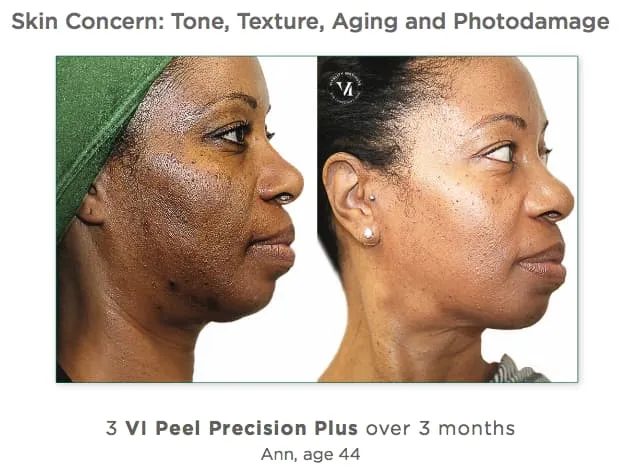
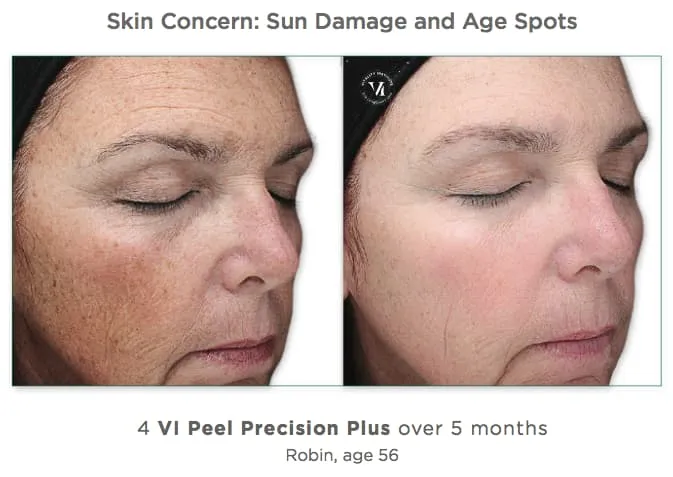
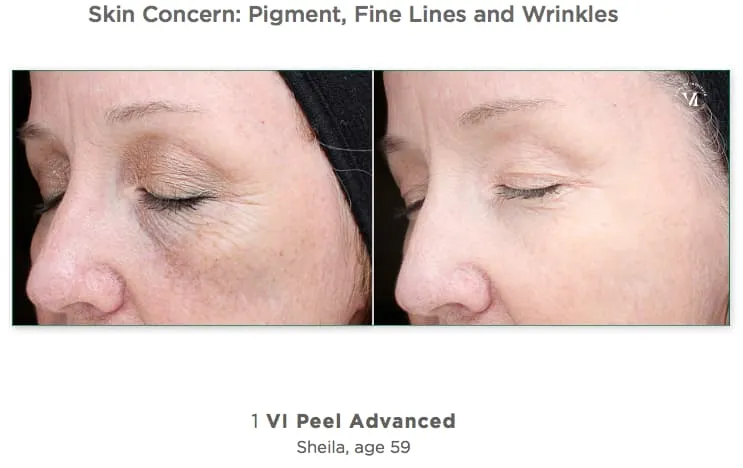
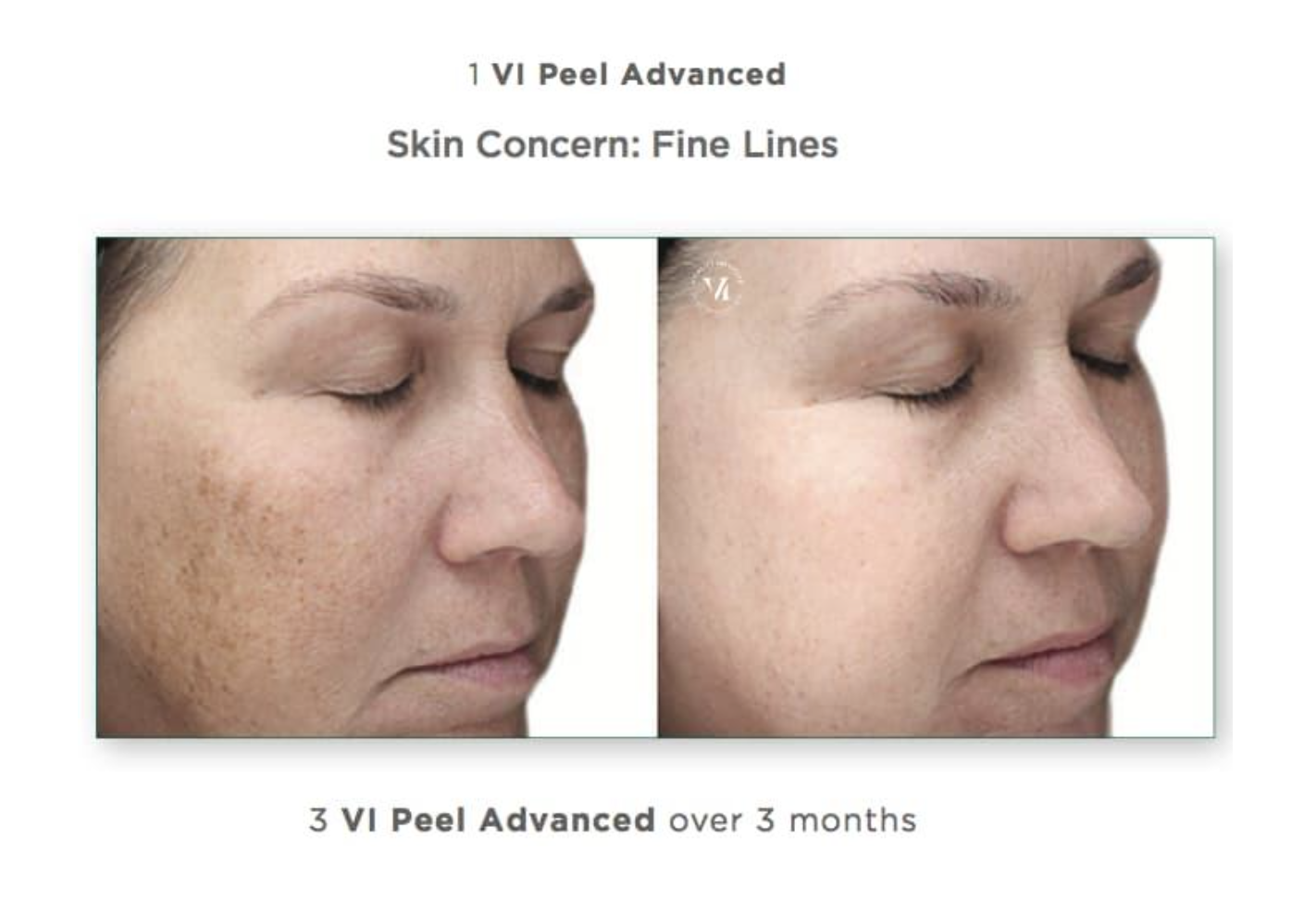
Solcara offers the VI Peel family: VI Peel Original, Advanced, Precision Plus, Purify, and Precision Plus with Purify. The manufacturer describes the blend as containing TCA, salicylic acid, and vitamin C.[7] The variations are chosen for different goals, such as pigment or acne, and we choose among them after looking at your skin. We also use other peels, including alpha-hydroxy acids (AHAs), beta-hydroxy acids (BHAs) such as salicylic acid, and TCA, when one of those is the better fit.
Peels are not only for the face. We can treat the neck, chest, hands, and back. Some patients pair a peel with a facial or a laser micro-peel, and we will talk through whether combining treatments makes sense for your skin and your schedule.
For a VI Peel, the manufacturer says peeling usually starts around day three and lasts about three to four days.[6] The manufacturer recommends a series of 3 to 6 peels spaced 4 to 6 weeks apart.[6] We commonly suggest a series of 3 to 4 VI Peels, but the right number depends on what you are treating. The manufacturer also states that VI Peel is not for people who are pregnant or breastfeeding.[6] If either applies to you, tell us, and we will wait or suggest another option.
Your two weeks before and after
Most of what decides a good result happens outside the treatment room. Before a peel, we ask you to avoid sun and tanning for two weeks. We ask you to stop retinoids and exfoliating products one to two weeks ahead, and to skip waxing and threading on the area being treated. Like the pre-peel plan the AAD describes, these steps are meant to cut down on side effects and help your skin respond the way we planned.[2]
After the peel, let the skin shed on its own. Do not pick, rub, or scratch the peeling skin. The AAD warns that rubbing or scratching treated skin can cause an infection.[2] Use a gentle cleanser and a plain moisturizer, and wear SPF 30 or higher every day. The AAD says to use sunscreen daily once the skin heals, and to avoid tanning beds entirely.[2] The ASDS adds that sun exposure and smoking after a peel can cause unwanted side effects.[3]
Expect results to fade slowly over time. The AAD notes that most peel results are not permanent, because skin keeps aging.[2] Daily sunscreen and a steady home routine protect what the peel achieved, and some people return for maintenance peels. Individual results vary.
When you are ready, Ashley Harwyn, PA-C, will look at your skin, ask about your history, and recommend a peel only if one fits. She is board certified in anti-aging and functional medicine through A4M. You can see her at our Mount Pleasant office on Bramson Court or at The Longevity Club on Rutledge Avenue, in the downtown Charleston medical district.
Hyperpigmentation
For melasma, sun spots, and dark marks that need a careful plan. Read Hyperpigmentation.
Acne and Acne Scars
When breakouts or the marks they leave are the main concern. Read Acne and Acne Scars.
Microneedling
A different way to work on texture and shallow scarring. Read Microneedling.
Skin Care
The home routine that keeps peel results longer. Read Skin Care.
 Ashley Harwyn, PA-C
PA-C, ABAAHP · Founder, Solcara Health
Online
Tap a question to ask
Find the peel that fits your skin
Book a skin visit with Ashley. Bring a list of the products you use and any past reactions to treatments.
BOOK A CONSULTATION →Or call 843-981-0870
Ashley Harwyn, PA-C, ABAAHP
Founder, Solcara Health · Diplomate, American Board of Anti-Aging Health Practitioners (ABAAHP)
Ashley has practiced medicine for more than fifteen years. Her path into it began at home, with a family member born with a congenital heart defect and a childhood spent watching how much the quality of a clinician's attention could change the shape of a life. She has since practiced across a range of settings, including medical mission work in Uganda, before founding Solcara to build the kind of practice she kept wishing existed, one that treats patients as whole people and tells them the truth about what the evidence does and does not support.
Full bio →References
The American Academy of Dermatology chemical peel overview and FAQs, the American Society for Dermatologic Surgery chemical peel page, peer-reviewed reviews on peels in skin of color (British Journal of Dermatology) and postinflammatory hyperpigmentation (Journal of Clinical and Aesthetic Dermatology), and VI Peel manufacturer information used for ingredients and product instructions only, each accessed October 4, 2026.
- American Academy of Dermatology. Chemical peels: Overview. AAD. aad.org
- American Academy of Dermatology. Chemical peels: FAQs. AAD. aad.org
- American Society for Dermatologic Surgery. Chemical peels. ASDS. asds.net
- Salam A, Dadzie OE, Galadari H. Chemical peeling in ethnic skin: an update. British Journal of Dermatology. 2013. pubmed.ncbi.nlm.nih.gov
- Davis EC, Callender VD. Postinflammatory hyperpigmentation: a review of the epidemiology, clinical features, and treatment options in skin of color. Journal of Clinical and Aesthetic Dermatology. 2010. pmc.ncbi.nlm.nih.gov
- VI Derm Beauty. VI Peel frequently asked questions (manufacturer information). VI Peel. vipeel.com
- VI Derm Beauty. Treating darker skin tones (manufacturer information, cited for ingredients only). VI Peel. vipeel.com
Medical Disclaimer: This page is for educational and informational purposes only and does not constitute medical advice, and reading it does not create a patient-provider relationship. It describes general medical information and categories of care, not a recommendation that any individual start, stop, or change any test, treatment, or medication. Any diagnosis or treatment decision requires evaluation by a qualified, licensed clinician who knows your personal and family history. Consult a qualified healthcare provider before making medical decisions. Information reflects sources available as of October 4, 2026.
Ashley Harwyn, PA-C, ABAAHP, is a Diplomate of the American Board of Anti-Aging Health Practitioners (ABAAHP) through A4M and the founder of Solcara Health. Solcara serves South Carolina from Downtown Charleston (163 Rutledge Ave, Ste 202, The Longevity Club) and Mt. Pleasant (496 Bramson Ct, Ste 120).
Chemical Peels FAQ's

Quick Links