

Reviewed by Ashley Harwyn, PA-C, ABAAHP | A4M Board Certified | Updated October 4, 2026
Sun spots, melasma, and post-acne marks look alike but need different plans. Here is what light and laser can clear, what they can worsen, and when creams come first.
Getting that order right is most of the job. A laser treatment that clears a sun spot in a session or two can make melasma darker if it is used too aggressively or too early.[5] A spot that looks like an age spot can also be a skin cancer, so some spots need an exam before anyone tries to fade them.[1] So your first visit is about the spot itself, your skin tone, and your sun habits, not about picking a package.
- Hyperpigmentation is a group of problems, mainly sun spots (age spots), melasma, and dark marks left after acne or other skin irritation, and each has its own best first step.[1][2][4]
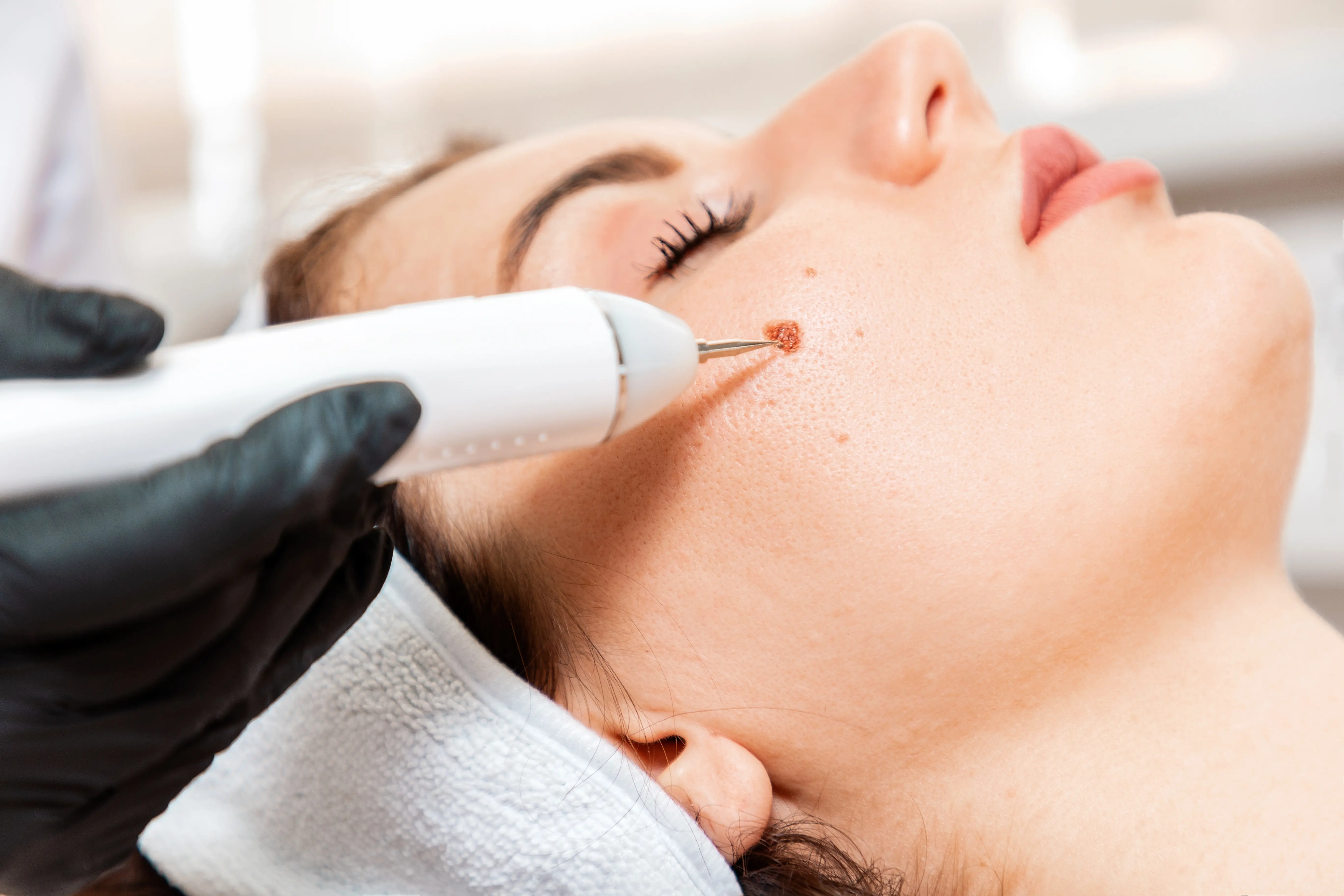
- Sun spots often respond well to light and laser treatment. The AAD says one or two laser treatments can treat age spots quickly.[1]
- Melasma is different. The AAD lists prescription creams and sun protection first, with procedures such as laser added to the plan, and results usually take 3 to 12 months.[2]
- Laser and light can lighten melasma, but recurrence is common and some devices raise the risk of new dark or light patches, so we use them cautiously and later in the plan.[5]
- Visible light, not just UV, can worsen melasma, which is why a tinted sunscreen with iron oxide is part of treatment.[3]
- Any spot that is new, changing, or unusual should be examined before it is treated, because fading a skin cancer can delay its diagnosis.[1]
Sun spot, melasma, or a mark left behind?
Hyperpigmentation simply means some skin has made extra melanin, the pigment that gives skin its color.[4] Three patterns account for most of what people ask us about. Sun spots, also called age spots or solar lentigines, are flat brown spots that appear where the sun hits most often, such as the face and hands.[1] Melasma shows up as larger patches on the face, and it is set off by sun, pregnancy, stress, some medicines, and other triggers.[3][5] The third group is post-inflammatory hyperpigmentation (PIH): dark marks that linger after acne, a wound, a rash, or an irritating product.[4]
These look similar in a mirror, but they behave very differently, and that changes the plan.
| Type of spot | What usually sets it off | Where we usually start | Where light or laser fits |
|---|---|---|---|
| Sun spot (age spot, solar lentigo) | Sun on often-exposed skin like the face and hands[1] | Skin exam, then treatment if the spot is benign[1] | Often the main treatment, one or two sessions[1] |
| Melasma | Sun, visible light, pregnancy, birth control pills, stress[3] | Tinted iron-oxide sunscreen plus prescription creams[2][3] | An add-on for stubborn cases, used with caution[2][5] |
| Dark marks after acne or irritation (PIH) | Acne, wounds, rashes, irritating products[4] | Calm the cause, sunscreen, fading ingredients[4] | Sometimes, at gentle settings, after the skin is calm |
Details worth mentioning to Ashley
Tap any that describe you. This cannot tell you what kind of pigment you have. It points out details that change how your treatment gets planned.
Timelines also differ. The AAD notes that a dark mark a few shades darker than your natural skin usually fades within 6 to 12 months, while melasma treatment usually takes 3 to 12 months to show results.[2][4] Knowing which one you have tells you what a fair wait looks like.
Clearing sun spots with light and laser
Sun spots are where light- and laser-based treatment tends to do its best work. The energy is aimed at the extra pigment in the spot, so the skin around it is left mostly alone. The AAD says one or two laser treatments can treat age spots quickly and that results tend to last longer than a fading cream.[1] The tradeoff is a short stretch of crusting or temporary darkening that creams do not cause.[1]
The research supports that, with a fair caveat. A 2023 systematic review of 48 studies and 1,763 patients found complete clearing in 43% of laser-treated cases, 21% with topical retinoids, 15% with freezing, and 6% with chemical peels. Combination treatments did best at 65%.[7] Those studies used different devices, settings, and patients, so the numbers are a guide to the pattern, not a promise for any one spot.[7] Side effects were reported in 23% of laser-treated cases in that review.[7]
Before we treat, every spot gets looked at. The AAD is direct about this: what looks like an age spot could be skin cancer, and fading one can give a cancer time to grow.[1] If a spot is new, growing, bleeding, irregular, or simply does not look like its neighbors, we will refer you for a dermatology exam or biopsy first. Treatment can wait a few weeks. A missed melanoma cannot.
After treatment, sun habits decide how long the result lasts. The AAD recommends a broad-spectrum, water-resistant sunscreen with SPF 30 or higher to keep new spots from forming.[1] Lowcountry sun is strong most of the year, so we plan on daily sunscreen as part of the treatment, not an optional extra.
Clearing sun spots, often in one or two sessions, once the spot has been examined, with a few days of crusting or temporary darkening and daily sunscreen afterward to keep new spots from forming.
As a one-session cure for melasma, which often returns and can darken with aggressive settings, as a wrinkle or pore fix, or as equally safe at the same settings for every skin tone.
Why melasma gets a different plan
Melasma is the reason we never treat every dark patch the same way. It tends to come back, it is triggered by things you cannot fully avoid, and irritation can make it darker.[3] The AAD lists sun exposure, pregnancy, stress, a medical condition, and medicines such as birth control pills among the triggers.[3] For many people it lasts for years, or even a lifetime.[2]
The first line is daily protection and prescription creams. The AAD describes hydroquinone, a tretinoin combination, and a triple cream that pairs tretinoin, a corticosteroid, and hydroquinone, with azelaic acid, kojic acid, or vitamin C as gentler options.[2] A Cochrane review of 20 randomized trials found the triple cream lightened melasma more than hydroquinone alone.[6] That same review rated the overall quality of melasma studies as generally poor, so even the best-studied creams have limits.[6]
Sunscreen needs extra thought here. The AAD notes that visible light has been shown to worsen melasma, especially in darker skin tones, and recommends a tinted sunscreen with iron oxide and an SPF of 30 or higher.[3] The AAD also says products that burn or sting can darken dark spots, and that tanning beds can worsen melasma and keep treatment from working.[3]
Where do lasers and light fit? The AAD lists laser and light treatments as options a dermatologist may add to a melasma plan, not as a starting point.[2] A review of laser and light therapy for melasma found that the common devices can lighten it, but recurrence over time is high.[5] Some techniques raise the risk of new dark or light patches. That review warned that ablative fractional lasers carry a very high risk of both, and found vascular-specific lasers ineffective for melasma.[5] So if light or laser joins your plan, it comes after creams and sun protection have done what they can, at gentle settings, with the expectation that maintenance will be needed.
Not sure if your patches are melasma or sun damage? Call 843-981-0870. Ashley will look at the pattern with you, explain which treatments suit it, and point out the ones that could make it darker.
Dark marks after acne, and treating darker skin safely
The marks that stay after a pimple heals are often PIH, not scarring. They are flat and brown, and they can outlast the acne itself by many months.[4] The AAD lists acne, wounds, some medicines, irritating products, and hormonal changes as common triggers.[4] The single most useful step is stopping new marks from forming, which usually means getting the acne itself under control through acne treatment.
For fading existing marks, the AAD names azelaic acid, glycolic acid, kojic acid, a retinoid, and vitamin C, along with a tinted sunscreen with iron oxide, SPF 30 or higher, and broad-spectrum, water-resistant protection.[4] Patience matters. A mark a few shades darker than your skin usually fades within 6 to 12 months, and deeper discoloration can take longer.[4]
Darker skin needs a careful hand with any energy-based treatment. In a review of laser and light treatment for melasma, lighter skin types generally carried less risk of new dark or light patches. That review found broadband light (IPL) best suited to lighter skin, because in darker skin it is more likely to hit normal pigment too.[5] It also suggested small test spots, done weeks ahead, when those devices are used on darker skin.[5]
That is why we take a thorough history first: past dark marks from bug bites, waxing, burns, or earlier treatments tell us how your skin tends to react. If your history suggests a laser or light session is likely to cause more marks than it clears, we will say so and build the plan around topicals, sun protection, and gentler procedures instead.
Planning your visit and protecting the result
Your first visit is a skin evaluation with Ashley Harwyn, PA-C, who is board certified in anti-aging and functional medicine through A4M and holds ABAAHP certification. She will look at each spot, ask about your sun exposure, hormones, medicines, and skin history, and sort out which type of pigment you are dealing with. Any spot that needs a dermatologist's exam gets referred before anything is treated. From there, the plan may be light or laser for sun spots, a cream-first approach for melasma, or a mix that adds a chemical peel or medical-grade home care.
Expect a series rather than a single visit for most pigment problems, and expect some upkeep. Melasma in particular tends to return without daily protection, and new sun spots keep forming as long as the sun keeps reaching your skin.[1][5] We would rather tell you that up front than promise a permanent fix.
You can see Ashley at our Mount Pleasant office on Bramson Court or at The Longevity Club on Rutledge Avenue, in downtown Charleston's medical district. Individual results vary, and we will tell you plainly if a treatment is unlikely to help your type of pigment.
Laser Services
An overview of every laser treatment we offer and how they differ. Read Laser Services.
Chemical Peels
A nonlaser option that can help some pigment and texture problems. Read Chemical Peels.
ZO Skin Health
The medical-grade home care line we use to support pigment treatment. Read ZO Skin Health.
Skin Rejuvenation
For sun damage that goes beyond a few spots. Read Skin Rejuvenation.
 Ashley Harwyn, PA-C
PA-C, ABAAHP · Founder, Solcara Health
Online
Tap a question to ask
Know your spot before you treat it
Book a skin visit with Ashley. If your spots change with the seasons, bring a photo from a darker month.
BOOK A CONSULTATION →Or call 843-981-0870
Ashley Harwyn, PA-C, ABAAHP
Founder, Solcara Health · Diplomate, American Board of Anti-Aging Health Practitioners (ABAAHP)
Ashley has practiced medicine for more than fifteen years. Her path into it began at home, with a family member born with a congenital heart defect and a childhood spent watching how much the quality of a clinician's attention could change the shape of a life. She has since practiced across a range of settings, including medical mission work in Uganda, before founding Solcara to build the kind of practice she kept wishing existed, one that treats patients as whole people and tells them the truth about what the evidence does and does not support.
Full bio →References
American Academy of Dermatology public guidance on age spots, melasma treatment and self-care, and dark spots in darker skin tones, a review of laser and light therapy in melasma (International Journal of Women's Dermatology), a Cochrane review of melasma treatments, and a systematic review of lentigo treatments (Dermatologic Surgery), each accessed October 4, 2026.
- American Academy of Dermatology. What can get rid of age spots?. AAD. aad.org
- American Academy of Dermatology. Melasma: Diagnosis and treatment. AAD. aad.org
- American Academy of Dermatology. Melasma: Self-care. AAD. aad.org
- American Academy of Dermatology. How to fade dark spots in darker skin tones. AAD. aad.org
- Trivedi MK, Yang FC, Cho BK. A review of laser and light therapy in melasma. International Journal of Women's Dermatology. 2017. pmc.ncbi.nlm.nih.gov
- Rajaratnam R, Halpern J, Salim A, Emmett C. Interventions for melasma. Cochrane Database of Systematic Reviews. 2010. pubmed.ncbi.nlm.nih.gov
- Mukovozov I, Roesler J, Kashetsky N, Gregory A. Treatment of Lentigines: A Systematic Review. Dermatologic Surgery. 2023. pubmed.ncbi.nlm.nih.gov
Medical Disclaimer: This page is for educational and informational purposes only and does not constitute medical advice, and reading it does not create a patient-provider relationship. It describes general medical information and categories of care, not a recommendation that any individual start, stop, or change any test, treatment, or medication. Any diagnosis or treatment decision requires evaluation by a qualified, licensed clinician who knows your personal and family history. Consult a qualified healthcare provider before making medical decisions. Information reflects sources available as of October 4, 2026.
Ashley Harwyn, PA-C, ABAAHP, is a Diplomate of the American Board of Anti-Aging Health Practitioners (ABAAHP) through A4M and the founder of Solcara Health. Solcara serves South Carolina from Downtown Charleston (163 Rutledge Ave, Ste 202, The Longevity Club) and Mt. Pleasant (496 Bramson Ct, Ste 120).




Hyperpigmentation Treatment FAQ's

Quick Links
