

Reviewed by Ashley Harwyn, PA-C, ABAAHP | A4M Board Certified | Updated October 4, 2026
ALASTIN is a recovery-focused cosmetic line we use after lasers, peels and microneedling. Here is what its studies show and the aftercare steps that count with any brand.
The line is built around a peptide blend the company calls TriHex Technology. The maker describes it as supporting the skin's repair framework and helping recovery after procedures.[2] Some of that has been tested in randomized trials, but the trials are small, and the ones we cite were funded by Galderma, ALASTIN's parent company, or run with authors paid by it.[2][3] Below: what that research shows, which products fit which procedure, and the recovery steps that matter with any brand.
- ALASTIN products are cosmetics. Cosmetics do not need FDA approval before they are sold, and a product meant to change the structure or function of the body would legally be a drug.[1]
- In two Galderma-funded trials after CO2 laser and radiofrequency microneedling (26 and 25 people), the main measure, redness rated by the investigator, was not significantly better on the serum side than with a basic moisturizer.[2]
- Some secondary measures, such as early swelling and skin water loss, did favor the serum.[2]
- The elastin claim rests on biopsies from one patient per group in a 10-person trial.[3]
- Plain white petrolatum healed surgical wounds as well as an antibiotic ointment in a 922-patient trial, with no allergic reactions.[6]
- No product makes up for picking at crusts or skipping sun protection on healing skin.[4][5]
What ALASTIN is, and what a cosmetic label can promise
Under US law, a cosmetic is something you apply to cleanse, beautify or change how you look. A product intended to treat disease or to affect the structure or function of the body is a drug, and drugs generally need FDA approval before sale.[1] Cosmetics, apart from color additives, do not.[1] Intended use is judged partly from what the label and advertising say, so a claim that a cream rebuilds collagen is the company's statement, not an FDA finding.
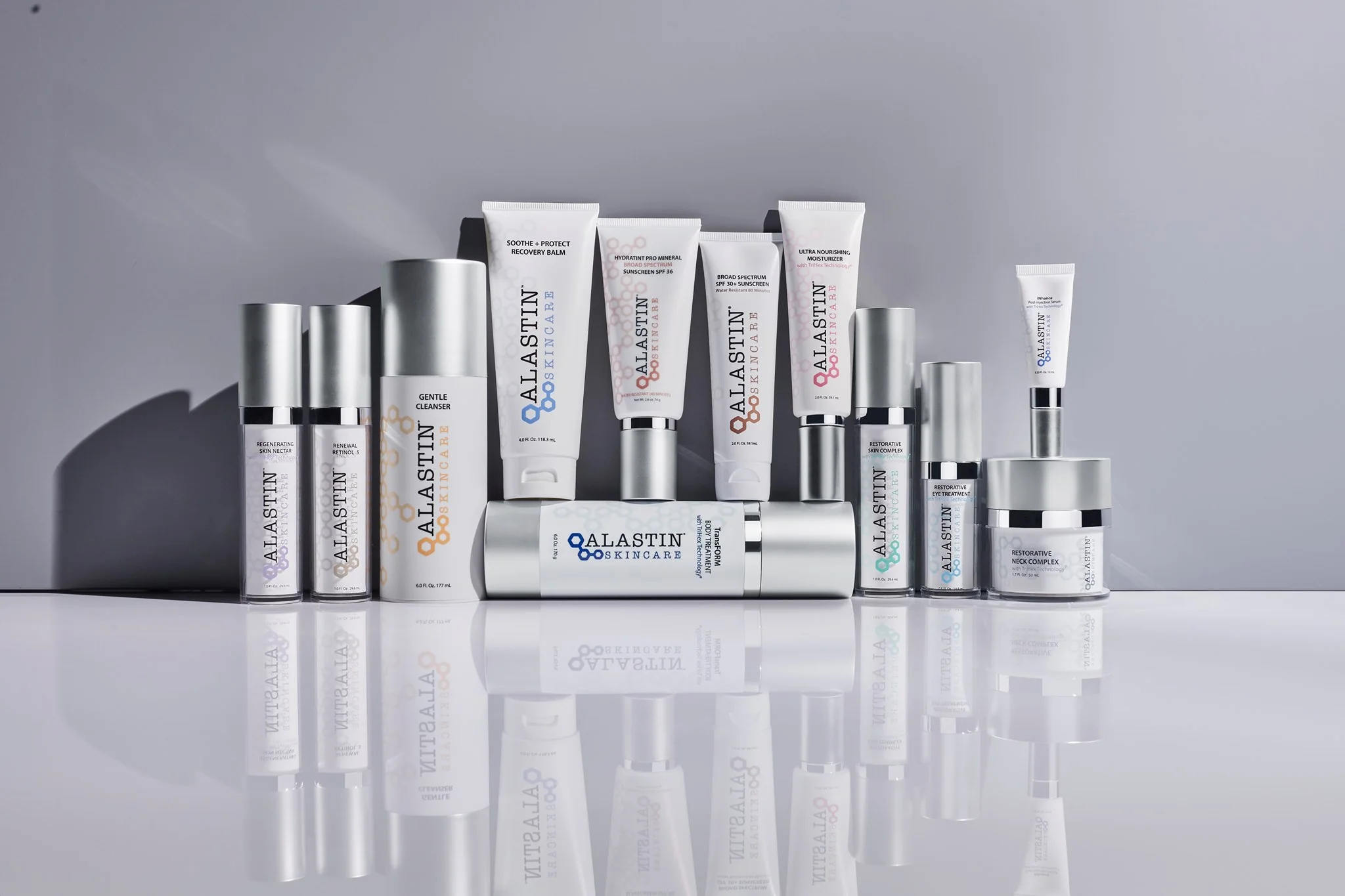
The products we use most are tied to recovery. Regenerating Skin Nectar is the serum used in most of the published trials. Its listed ingredients include the two TriHex peptides (palmitoyl tripeptide-1 and palmitoyl hexapeptide-12), arnica, soybean oil and a form of panthenol in a water-free silicone base.[2] Soothe + Protect Recovery Balm and Restorative Eye Treatment are other parts of the line we may suggest after a procedure. ALASTIN Skincare is a Galderma company.[3] That matters when you read the research, because the company paid for or helped run the trials below.
What the TriHex research actually tested
The largest recent report combined two randomized, split-face trials published in 2026. One group of 26 adults had fractional CO2 laser, and another group of 25 had radiofrequency microneedling. Each person used Regenerating Skin Nectar on one half of the face and a basic moisturizer on the other, and a blinded evaluator scored both sides for 14 days.[2]
The main outcome was redness as rated by the investigator. Both sides improved, but the difference between sides was not statistically significant in either trial.[2] Some secondary measures did favor the serum after correction for multiple comparisons: less skin water loss on day 3, and less swelling, measured redness and roughness by day 14 after CO2 laser, plus less swelling on day 7 after microneedling. By day 14, 81.8% of the laser group and all of the microneedling group reported better overall recovery on the serum side.[2] Side effects were few and mild.[2]
The authors called the studies exploratory, with modest sample sizes and no formal calculation of how many people were needed. Participants could not be blinded, because the two products looked and felt different, which can tilt self-reported results. They concluded that more controlled studies are needed.[2] Both trials were funded by Galderma, and three authors were Galderma employees.[2]
The collagen and elastin claim traces back to smaller work. In a 2022 trial, 10 people having laser treatment for acne scars were randomized to Regenerating Skin Nectar or a bland moisturizer. The serum group had less water loss and redness, and better scar scores.[3] The “new elastin” finding, though, came from biopsies of one patient in each group, and the authors themselves noted that the small size limited their conclusions.[3] The lead author reported grants from ALASTIN, and a co-author was Galderma's chief scientific officer.[3]
A fair reading: a TriHex serum may make the first one to two weeks after a laser or microneedling session a little calmer and more comfortable than a plain moisturizer. It has not been shown, in independent studies, to change your final result or to rebuild skin structure. We use it for comfort and consistency, and we tell patients that a simpler routine is a reasonable choice.
A TriHex serum used around a laser or microneedling session may ease early swelling and skin water loss and feel better to patients than a plain moisturizer during the first two weeks, in small company-funded trials.
Saying it rebuilds collagen and elastin (the human elastin finding came from one biopsy per group), that it shortens recovery as a fact (the main redness outcome did not beat a moisturizer), or that a physician-dispensed cosmetic is FDA-reviewed.
Matching aftercare to the procedure
Recovery care should follow the injury, not the brand. Here is where a product like ALASTIN fits, set against what specialty societies tell patients to expect.
| Procedure | What healing usually looks like | Care that matters most | Where an ALASTIN product can fit |
|---|---|---|---|
| Light chemical peel | Red for 1 to 7 days[5] | Lotion or cream until healed, then daily sunscreen[5] | A gentle moisturizer or balm while skin is tender |
| Medium chemical peel | Red and swollen for 7 to 14 days[5] | Soaks, ointment after each soak, no sun until healed, antiviral if prescribed[5] | Only after your clinician says the skin has closed |
| Laser resurfacing | Dry and peeling 5 to 7 days in, then pink for 2 to 3 months or longer[4] | Cleaning as directed, protective products your clinician recommends, ice early on, no picking[4] | The best-studied use: a TriHex serum as an add-on[2] |
| Radiofrequency microneedling | Redness and swelling that ease over about 2 weeks in one trial[2] | Gentle cleanser, moisturizer, sun protection | Studied as an add-on; swelling eased faster on the serum side[2] |
| Fillers or neurotoxins | Skin is only pierced at small points | Your injector's site-specific instructions | Usually optional |
Points to bring up before your procedure
Tap anything that is true for you. Each one is a topic to raise at your visit so your aftercare plan fits, not a verdict on any product.
The laser row describes the heavier end of recovery, and a gentler laser facial heals faster. Timing matters too. In the laser trials, the serum was started about two weeks before treatment and continued after it, so a product handed to you on the day is not the plan that was studied.[2][3] After injectables, the bigger aftercare job is knowing the warning signs, which are covered on our dermal fillers and neurotoxins pages.
Booked a laser or peel and unsure what to put on afterward? Your aftercare should match the treatment you are having, and it does not have to be expensive. Call 843-981-0870 and we will write out a simple plan for the first two weeks, including which products are worth buying and which ones you can skip.
Recovery basics that matter more than any brand
Keep it clean, gently. Use lukewarm water, a mild cleanser and your fingertips, then pat dry. After laser resurfacing, cleaning is often done several times a day with a solution your clinician chooses.[4]
Keep it moist. Dermatologists recommend petroleum jelly on healing skin because it stops the wound from drying out and forming a scab.[7] Plain is fine. In a randomized, double-blind trial of 922 patients after skin surgery, white petrolatum healed as well as an antibiotic ointment. Infection rates were 2.0% and 0.9%, a difference that was not statistically significant, and no one using petrolatum developed an allergic rash, compared with four people on the antibiotic.[6] If you prefer the feel of a recovery balm, that is a fine choice too, as long as the skin stays covered and moist.
Do not pick. Picking or scratching crusts after laser resurfacing can cause scarring, and rubbing skin after a peel can cause infection.[4][5] Let flaking skin come off on its own.
Protect it from the sun. After a medium peel, the advice is to avoid the sun completely until the skin heals.[5] Once healed, sunscreen goes on every day.[4][5] New laser skin can stay pink for months, so daily protection is part of the recovery, not an extra.[4]
Be cautious with darker skin. People with skin of color can have peels safely, but the American Academy of Dermatology warns that treatment by someone without that experience can lead to permanent pigment problems.[5] Gentle products and steady sun protection afterward matter even more.
Ask before restarting active products. Retinoids, acids and scrubs are easy to restart too early, while the skin is still tender. We will tell you when to add them back. Makeup can usually go back on once the skin has healed, and an oil-free formula is the safer choice.[4]
Call if something is off. Pain that gets worse instead of better, spreading redness, pus, fever, or new cold sores after a laser or peel should be checked by us, not treated with another cream.
Choosing recovery products with us
You do not need a full kit. Most people need four things: a mild cleanser, something to keep the skin moist (petrolatum or a recovery balm), a moisturizer for the weeks after, and a broad-spectrum sunscreen once the skin has closed. Before you spend more, ask three questions. Does it fit my procedure? Is the benefit shown in independent studies, or only the company's own? Will I actually use it twice a day for two weeks?
We stock ALASTIN because its recovery products are pleasant to use and were designed for the weeks around a procedure, and a routine you like is one you keep. If budget is tight, or your skin reacts easily, we will build your aftercare around plain petrolatum and a basic fragrance-free moisturizer, and that is not second best. For longer-term skin goals such as tone, texture or acne, our other line, ZO Skin Health, may fit better.
Ashley Harwyn, PA-C, is board certified in anti-aging and functional medicine (A4M) and holds ABAAHP certification. She will plan your aftercare with you before a skin procedure, at our Mount Pleasant office, 496 Bramson Ct, Suite 120, or at The Longevity Club downtown, 163 Rutledge Ave, Suite 202. Bring a list of the products you already use, since part of your routine can often stay.
Skin Resurfacing
The laser treatment where recovery products have been studied most. Read Skin Resurfacing.
Chemical Peels
Light and medium peels, and what healing takes for each. Read Chemical Peels.
Microneedling
A shorter recovery that still benefits from careful aftercare. Read Microneedling.
Medical Skin Care
The daily routine that matters once you have healed. Read Medical Skin Care.
 Ashley Harwyn, PA-C
PA-C, ABAAHP · Founder, Solcara Health
Online
Tap a question to ask
Plan your recovery before your procedure
Book your treatment consult with Ashley and ask for a written aftercare plan. Bring the skin products you already own.
BOOK A CONSULTATION →Or call 843-981-0870
Ashley Harwyn, PA-C, ABAAHP
Founder, Solcara Health · Diplomate, American Board of Anti-Aging Health Practitioners (ABAAHP)
Ashley has practiced medicine for more than fifteen years. Her path into it began at home, with a family member born with a congenital heart defect and a childhood spent watching how much the quality of a clinician's attention could change the shape of a life. She has since practiced across a range of settings, including medical mission work in Uganda, before founding Solcara to build the kind of practice she kept wishing existed, one that treats patients as whole people and tells them the truth about what the evidence does and does not support.
Full bio →References
The FDA guidance on cosmetics versus drugs, two Galderma-funded randomized split-face trials in Dermatology and Therapy (2026), a 2022 randomized trial in Clinical, Cosmetic and Investigational Dermatology, the American Society of Plastic Surgeons laser resurfacing recovery page, the American Academy of Dermatology chemical peel and wound care pages, and a 1996 JAMA randomized trial of petrolatum versus bacitracin, each accessed October 4, 2026.
- US Food and Drug Administration. Is It a Cosmetic, a Drug, or Both? (Or Is It Soap?). FDA. 2024. fda.gov
- Liu Z, Yi Z, Wang P, et al. Efficacy and Safety of a Topical Skincare Regimen with Tripeptide/Hexapeptide following Aesthetic Procedures: Analysis of Two Randomized, Split-Face Trials in Asian Subjects. Dermatology and Therapy. 2026. pmc.ncbi.nlm.nih.gov
- Weinstein Velez M, Prezzano J, Bell M, Widgerow A. A Single Center, Prospective, Randomized, Blinded Study to Evaluate the Efficacy and Safety of a Topical Tripeptide/Hexapeptide Anhydrous Gel When Used Pre- and Post- Hybrid Fractional Laser for the Treatment of Acne Scars. Clinical, Cosmetic and Investigational Dermatology. 2022. pmc.ncbi.nlm.nih.gov
- American Society of Plastic Surgeons. Laser Skin Resurfacing Recovery. ASPS. plasticsurgery.org
- American Academy of Dermatology. Chemical Peels: FAQs. AAD. aad.org
- Smack DP, Harrington AC, Dunn C, et al. Infection and Allergy Incidence in Ambulatory Surgery Patients Using White Petrolatum vs Bacitracin Ointment: A Randomized Controlled Trial. JAMA. 1996. pubmed.ncbi.nlm.nih.gov
- American Academy of Dermatology. Minimize a Scar: Proper Wound Care Tips from Dermatologists. AAD. aad.org
Medical Disclaimer: This page is for educational and informational purposes only and does not constitute medical advice, and reading it does not create a patient-provider relationship. It describes general medical information and categories of care, not a recommendation that any individual start, stop, or change any test, treatment, or medication. Any diagnosis or treatment decision requires evaluation by a qualified, licensed clinician who knows your personal and family history. Consult a qualified healthcare provider before making medical decisions. Information reflects sources available as of October 4, 2026.
Ashley Harwyn, PA-C, ABAAHP, is a Diplomate of the American Board of Anti-Aging Health Practitioners (ABAAHP) through A4M and the founder of Solcara Health. Solcara serves South Carolina from Downtown Charleston (163 Rutledge Ave, Ste 202, The Longevity Club) and Mt. Pleasant (496 Bramson Ct, Ste 120).
ALASTIN Skincare® FAQ's

Quick Links
