

Reviewed by Ashley Harwyn, PA-C, ABAAHP | A4M Board Certified | Updated October 4, 2026
A tint darkens the brows and lashes you already have for a few weeks. Here is what each FDA source says about tint safety, how we protect your eyes, and the truth about lash serums.
The FDA has warned for years that permanent lash and brow dyes have caused serious eye injuries, including blindness.[1] Its pages also disagree with each other about whether any tint ingredient is allowed for this use, and we lay out both positions below with their sources. You will also find how we lower the risk at your visit, who should wait or skip, and what is true about lash growth serums.
- A brow or lash tint darkens the hairs you already have. It does not add hairs, and the color fades over about three to six weeks.[4]
- The FDA warns that permanent eyelash and eyebrow tints and dyes have caused serious eye injuries, including blindness.[1]
- A federal rule (21 CFR 73.2550) allows silver nitrate in professional-use-only lash and brow tints, at no more than 4 percent, not for anyone under 16, and on for no more than 1 minute.[2] The FDA's hair dye page still says no color additives are approved for brows or lashes.[3]
- Box hair dye should never go on your brows or lashes. Coal-tar hair dyes are not permitted for that use.[3]
- You can become sensitive to a dye after using it before without trouble, so a past good result is not a guarantee.[4]
- Latisse (bimatoprost) is the FDA-approved prescription drug for growing lashes. Many cosmetic lash serums are sold without FDA review, and some contain similar drug ingredients.[5][6][7]
What a tint changes, and what it leaves alone
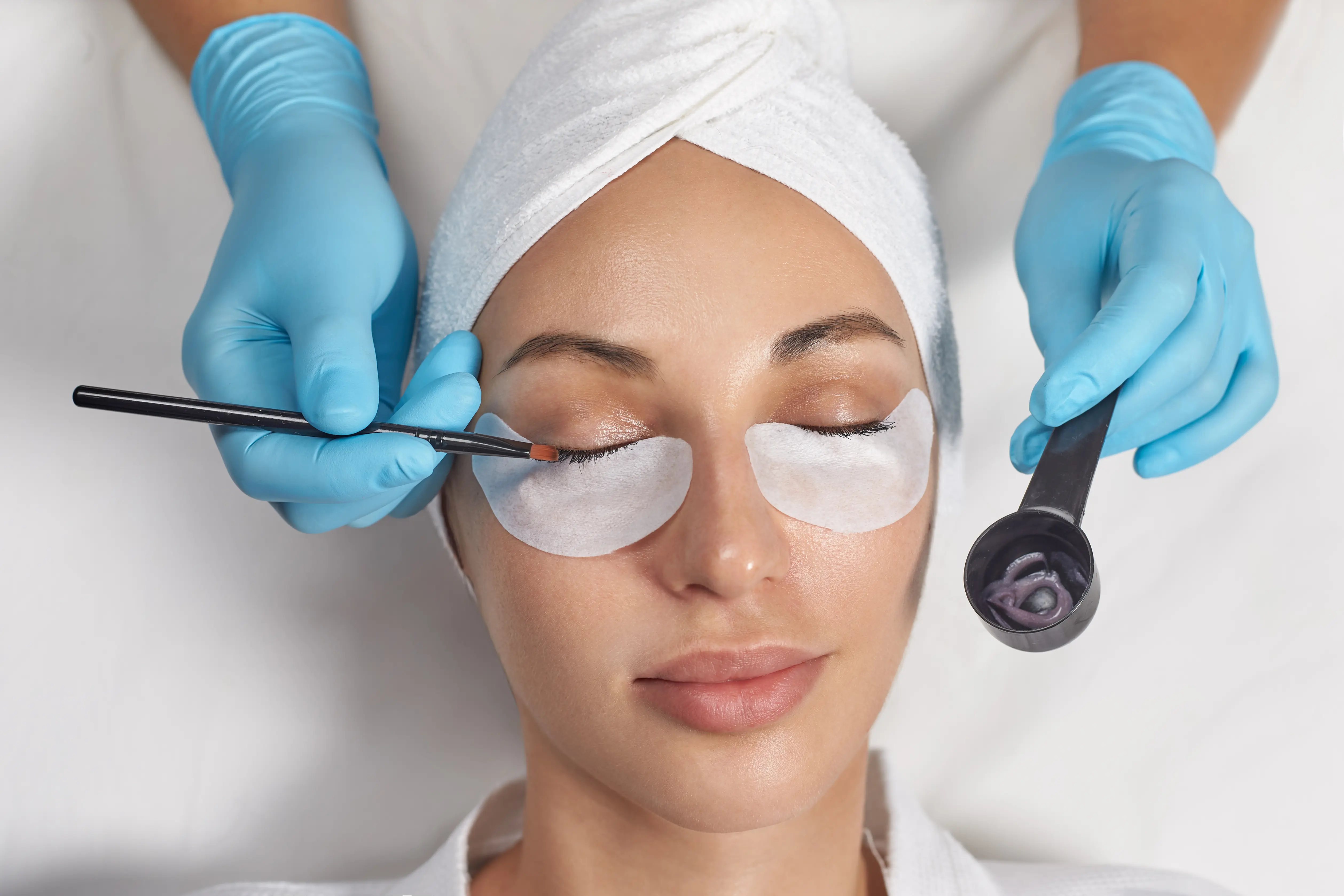
A tint is a color treatment for hair, not for skin. Your aesthetician shapes the area, protects the skin around it, paints a small amount of dye onto the brow or lash hairs, waits, and then removes it. The American Academy of Ophthalmology describes tinting as a 15-minute procedure that makes brows or lashes look thicker, darker, and fuller.[4] At Solcara, the tint can be paired with brow waxing in the same visit, so shape and color are handled together, or added on to one of our facials.
Light, fine, or graying hairs show the biggest change, because the tint makes hairs that were hard to see easier to see. It does not create new hairs, fill true gaps, or change the shape of a sparse brow. Those are jobs for brow pencil, a growth medicine, or a different service. A tint also does nothing for fine lines around the eyes, which is the job of a laser treatment such as SmoothEye.
The color is also not permanent. It lasts about three to six weeks, and it fades as hairs shed and new pale ones grow in.[4] Anyone who promises a tint will stay dark for months, or hold up in the sun all summer, is promising more than the dye can do. Most people simply rebook when the color starts to soften.
Darkens the brow and lash hairs you already have for about three to six weeks, using a product made for the eye area, applied by a trained professional after a skin test.
A result that stays dark for months or all summer in the sun, a way to grow longer or thicker lashes, or a risk-free quick fix. Growth takes a drug, and the dye works right beside your eye.
Two FDA positions on lash and brow dyes
Official sources say different things here, so this section gives each one in its own terms. Start with the warning that is not in dispute: permanent eyelash and eyebrow tints and dyes have been known to cause serious eye injuries, including blindness.[1] Hair dyes have also caused eye injuries, including blindness, when used in the eye area.[3]
On approval, the sources differ. In 2021, the FDA added a regulation, 21 CFR 73.2550, that allows silver nitrate as a color additive in externally applied, professional-use-only cosmetics that color eyebrows and eyelashes.[2] The rule comes with strict limits. The product may hold no more than 4 percent silver nitrate by weight. It is not intended for anyone under 16. It is applied by a professional for no more than 1 minute and then removed right away. It may not be sold directly to consumers.[2] The FDA's eye cosmetic page repeats those same limits.[1]
The FDA's hair dye page, current as of September 2025, says something different: color additives for dyeing brows or lashes need FDA approval for that use, and no color additives are approved for it.[3] An American Academy of Ophthalmology article from 2019, written before the silver nitrate rule, said the same.[4] We cannot settle that conflict for the agency. What we can do is tell you both, and use only products made for brows and lashes.
| Source | What it says about brow and lash color | Date |
|---|---|---|
| 21 CFR 73.2550 (federal regulation) | Silver nitrate is allowed in professional-use-only tints: up to 4%, age 16 and older, 1 minute at most[2] | Rule published October 2021 |
| FDA eye cosmetic safety page | Repeats the silver nitrate limits and warns of serious eye injuries from permanent tints[1] | Updated June 2022 |
| FDA hair dye page | No color additives are approved for dyeing brows or lashes[3] | Current as of September 2025 |
| FDA hair dye page | Coal-tar hair dye is never a permitted use on brows or lashes[3] | Current as of September 2025 |
Points to raise before any dye goes near your eyes
Tap each statement that is true for you. None of these is a diagnosis. Each is something your aesthetician should hear before your appointment.
One point is not in dispute. Coal-tar hair dye, the kind in most box hair color, must not be used on brows or lashes, and its label is required to warn that doing so may cause blindness.[3] The FDA also has an import alert on lash and brow dyes that contain coal tar colors.[1] Silver nitrate products carry their own required warning: they may permanently stain skin they touch and may irritate the eyes.[2]
How we keep your eyes safe during a tint
Most of the risk comes down to three things: what product touches you, how close it gets to the eye, and whether your skin reacts. We plan the visit around all three.
A skin test first. For hair dye, the FDA advises a patch test on your skin every time, before each use.[3] We apply the same habit to tints, because a reaction on a small patch of skin is far better than one on your eyelids. This matters even for returning clients. An American Academy of Ophthalmology spokesperson notes that people can become sensitive with repeated exposure, and formulas can change over time, so a dye you handled well last year can still cause a reaction now.[4]
Eye protection and timing. The skin around the eye is shielded before any dye goes on, the eyes stay closed during lash work, and the product comes off on time. Silver nitrate tint labels are required to say that if the product gets in your eyes, you should rinse them right away.[2]
The right product for the job. We use tints made for brows and lashes, never hair color. You are welcome to ask which product we will use and read its label before we start.
Knowing when to wait. The FDA advises against eye cosmetics while you have an eye infection or while the skin around the eye is inflamed, and suggests waiting until the area heals.[1] If you have had eye surgery recently or are being treated by an eye doctor, ask that doctor before you book. If you have reacted to a hair dye or tint before, tell us, and we may suggest skipping it. After any visit, if irritation continues, see a doctor.[1]
Want a tint but worried about your eyes? Call 843-981-0870 before you book. Tell us about past dye reactions, eye drops, or recent eye procedures, and we will plan a skin test first or tell you plainly if waiting is wiser.
Lash growth serums: prescription versus cosmetic
A tint makes lashes darker, but it cannot make them longer or fuller. Growth is a different question, and it belongs to drugs, not cosmetics. Under federal law, a cosmetic is meant to beautify or alter appearance, while a product meant to affect the structure or function of the body is a drug.[6] The FDA lists claims to restore hair growth as an example of a claim that makes a product a drug.[6]
Latisse (bimatoprost ophthalmic solution 0.03%) is the FDA-approved prescription drug for this. It is used once nightly along the upper lid at the base of the lashes.[5] In the main trial, 78 percent of people using it had at least a one-grade gain in overall lash prominence at week 16, compared with 18 percent on the inactive solution.[5] Most people do not see a meaningful change until about 2 months, and lashes return to where they started if you stop.[5]
It has real side effects. The most common, in about 3 to 4 percent of users, are itchy eyes, red eyes, and darker skin on the lids.[5] Lid darkening usually fades after stopping, but brown darkening of the colored part of the eye is likely permanent.[5] People who use prostaglandin eye drops for glaucoma should talk with their eye doctor first, because using both may weaken the pressure-lowering effect.[5]
Cosmetic lash serums are another story. Cosmetics, other than color additives, do not need FDA approval before they are sold.[6] A 2026 study of 79 cosmetic lash products found that about 30 percent contained a prostaglandin analog, the same drug family as Latisse, while the rest relied on ingredients such as castor oil, peptides, and panthenol.[7] Before you use any lash serum, including one offered as an add-on, read the ingredient list or ask us what is in it.
Booking a tint at either Solcara office
Tinting is offered at both of our offices: in Mount Pleasant at 496 Bramson Ct, Suite 120, and downtown at The Longevity Club, 163 Rutledge Ave, Suite 202, near the MUSC campus. Plan on a short visit, with extra time if you add brow waxing or a skin test.
When you book, mention any eye condition, recent eye procedure, contact lenses, glaucoma drops, or past reaction to hair color. Come with clean brows and lashes, free of mascara and brow makeup, if you can. Because Solcara is a medical practice, our clinician, Ashley Harwyn, PA-C, is part of the same team, which helps when a question about your eyes or skin goes beyond cosmetics.
Facials
A brow or lash tint can be added to a facial visit. Read Facials.
SmoothEye
For fine lines around the eyes, which a tint does not change. Read SmoothEye.
Skin Care
For daily care of the skin around your brows and eyes. Read Skin Care.
How long tint lasts
 Ashley Harwyn, PA-C
PA-C, ABAAHP · Founder, Solcara Health
Online
Tap a question to ask
Darker brows and lashes, with your eyes protected
Book a brow or lash tint, and tell us about any eye condition or past dye reaction so we can plan your skin test first.
BOOK A CONSULTATION →Or call 843-981-0870
Ashley Harwyn, PA-C, ABAAHP
Founder, Solcara Health · Diplomate, American Board of Anti-Aging Health Practitioners (ABAAHP)
Ashley has practiced medicine for more than fifteen years. Her path into it began at home, with a family member born with a congenital heart defect and a childhood spent watching how much the quality of a clinician's attention could change the shape of a life. She has since practiced across a range of settings, including medical mission work in Uganda, before founding Solcara to build the kind of practice she kept wishing existed, one that treats patients as whole people and tells them the truth about what the evidence does and does not support.
Full bio →References
FDA pages on eye cosmetic safety, hair dyes, and cosmetic versus drug rules, the federal silver nitrate regulation (21 CFR 73.2550), an American Academy of Ophthalmology article, the Latisse prescribing information on DailyMed, and a 2026 study of lash serums, each accessed October 4, 2026.
- U.S. Food and Drug Administration. Eye Cosmetic Safety. FDA. 2022. fda.gov
- U.S. Food and Drug Administration. 21 CFR 73.2550, Silver nitrate (color additive for eyebrows and eyelashes). Electronic Code of Federal Regulations. 2021. ecfr.gov
- U.S. Food and Drug Administration. Hair Dyes. FDA. 2025. fda.gov
- Vimont C, reviewed by Taylor RJ. Know the Risks of Eyebrow and Eyelash Enhancement. American Academy of Ophthalmology. 2019. aao.org
- Allergan, an AbbVie company. LATISSE (bimatoprost ophthalmic solution) 0.03% prescribing information. DailyMed, National Library of Medicine. 2024. dailymed.nlm.nih.gov
- U.S. Food and Drug Administration. Is It a Cosmetic, a Drug, or Both? (Or Is It Soap?). FDA. 2024. fda.gov
- Couteau C, Coiffard L. Prostaglandin analogues in cosmetic products formulated for eyelash lengthening. Annales Pharmaceutiques Francaises. 2026. pubmed.ncbi.nlm.nih.gov
Medical Disclaimer: This page is for educational and informational purposes only and does not constitute medical advice, and reading it does not create a patient-provider relationship. It describes general medical information and categories of care, not a recommendation that any individual start, stop, or change any test, treatment, or medication. Any diagnosis or treatment decision requires evaluation by a qualified, licensed clinician who knows your personal and family history. Consult a qualified healthcare provider before making medical decisions. Information reflects sources available as of October 4, 2026.
Ashley Harwyn, PA-C, ABAAHP, is a Diplomate of the American Board of Anti-Aging Health Practitioners (ABAAHP) through A4M and the founder of Solcara Health. Solcara serves South Carolina from Downtown Charleston (163 Rutledge Ave, Ste 202, The Longevity Club) and Mt. Pleasant (496 Bramson Ct, Ste 120).
Eyebrow & Lash Tinting FAQ's

Quick Links
